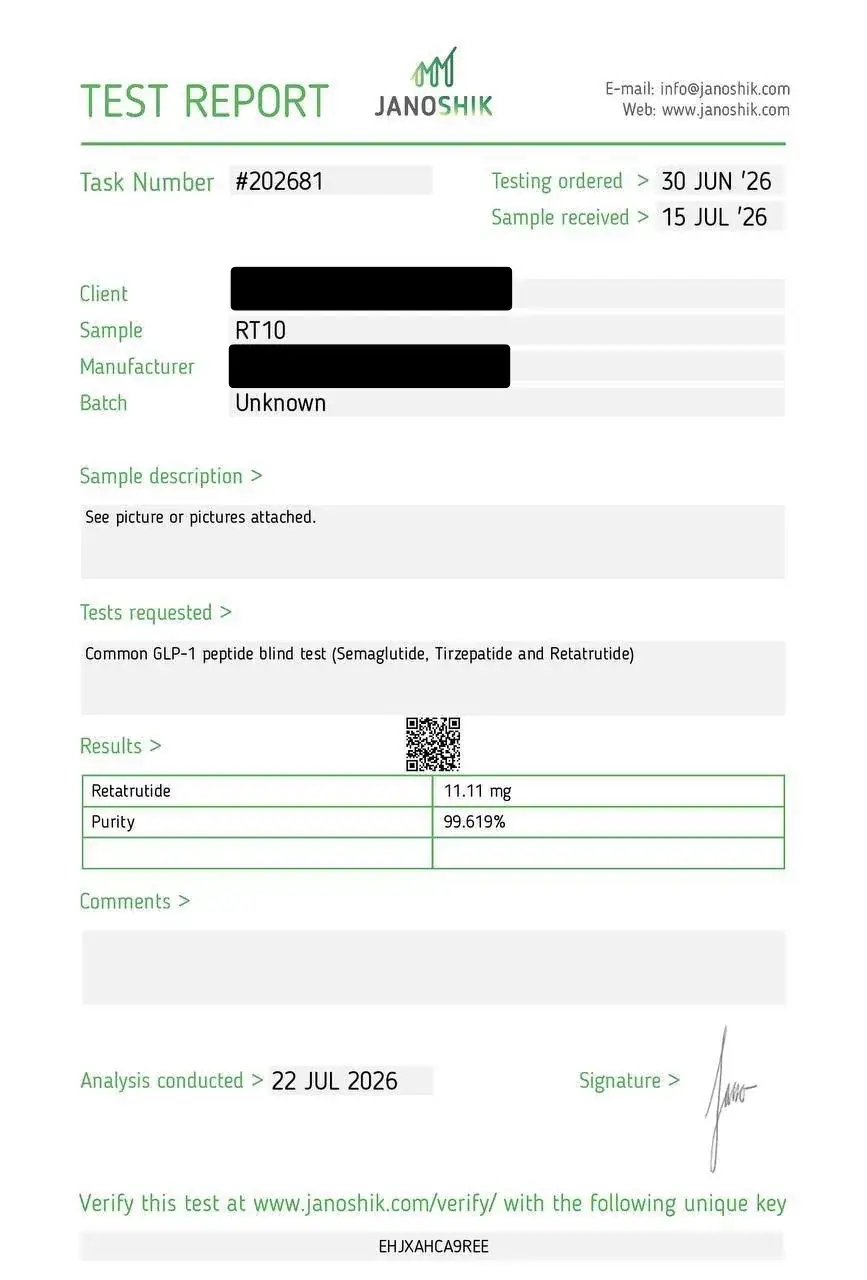
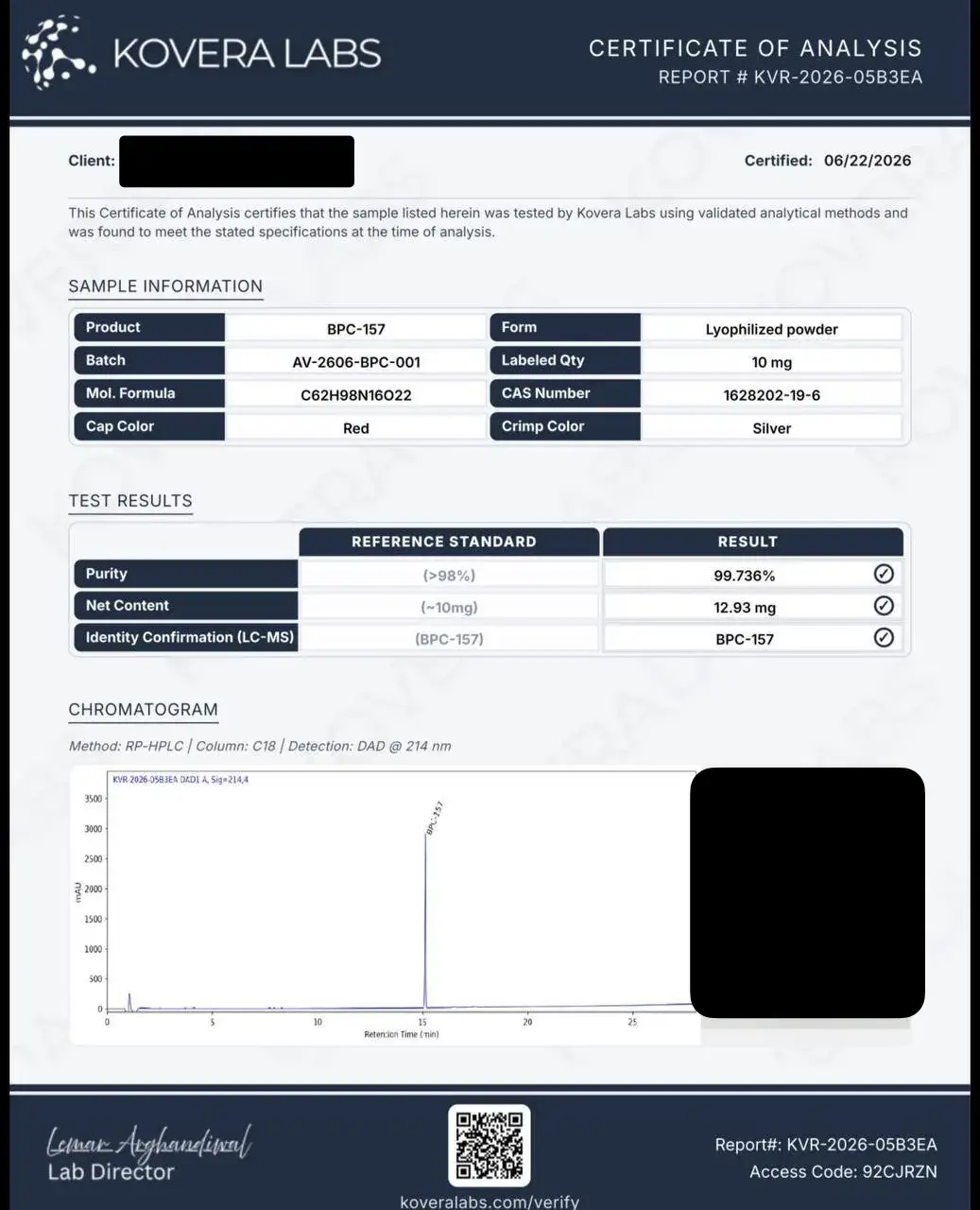
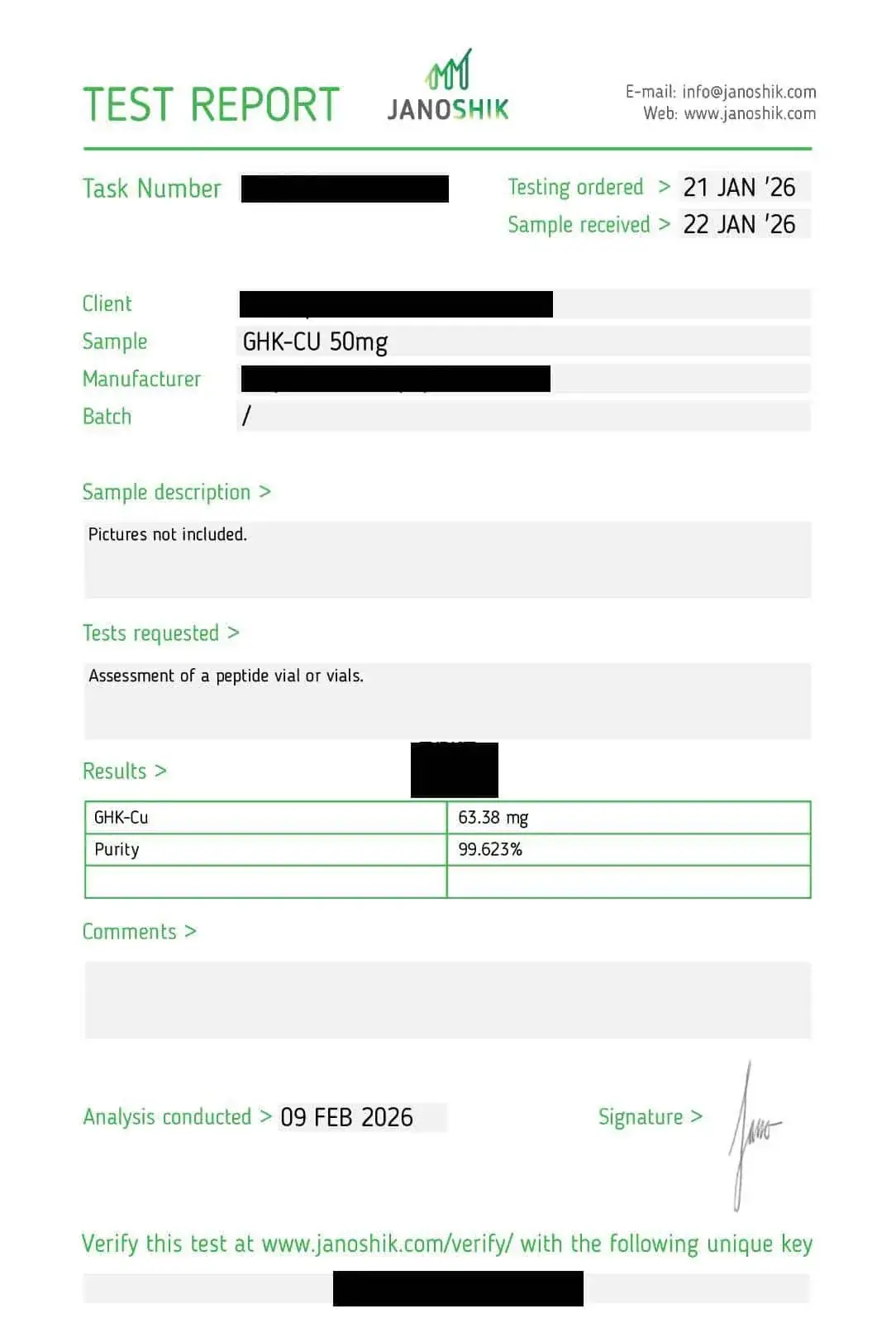
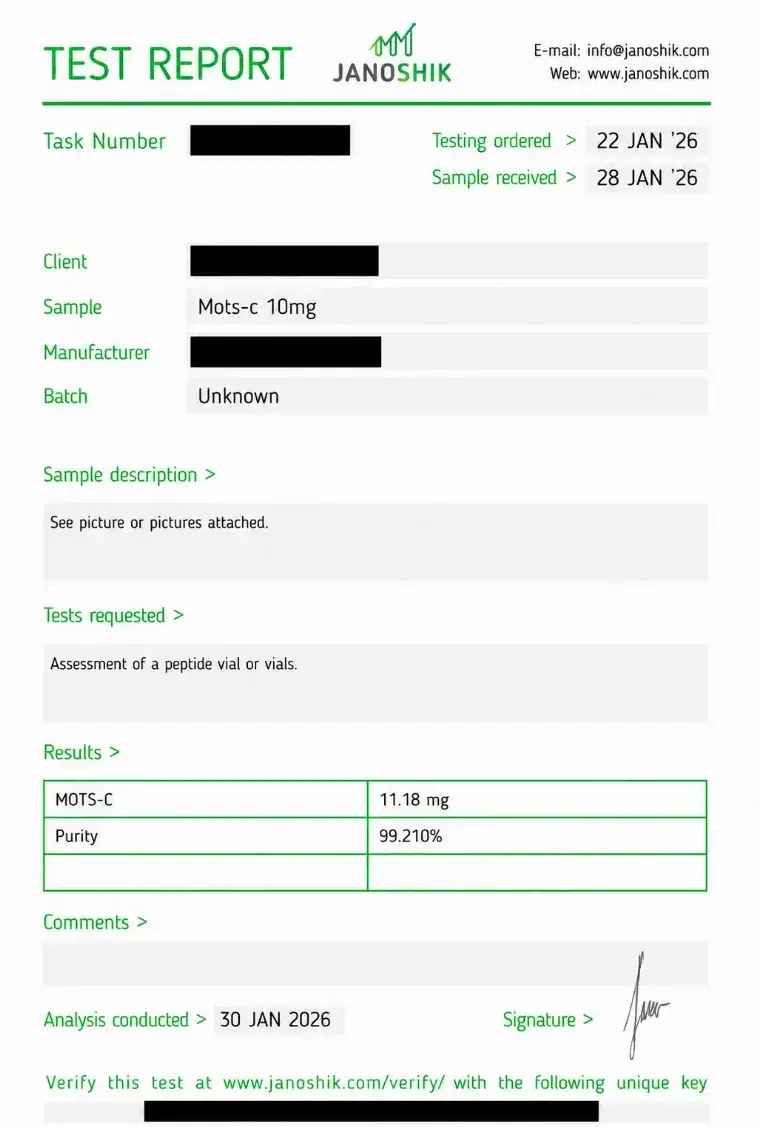
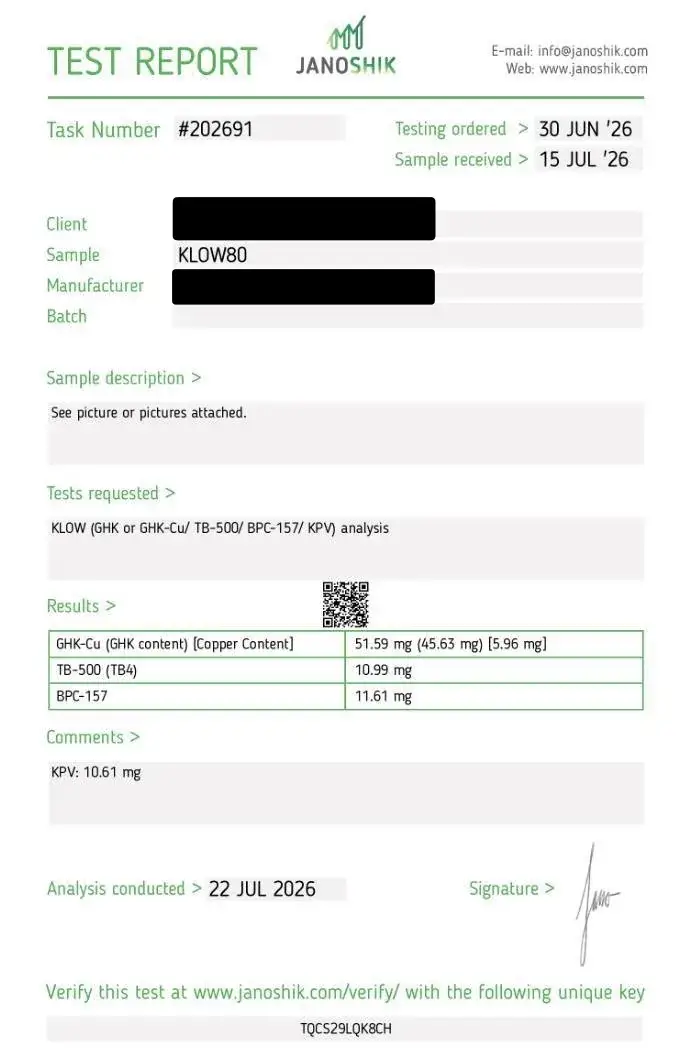
Here is how our testing works, stated plainly. Every stock order from our manufacturer comes with the manufacturer’s own laboratory report for that batch. Separately, independent laboratories — Janoshik and Kovera Labs — test product from the same manufacturer’s production line, and we publish those reports below in full. Some were commissioned by other buyers from the same manufacturer and shared with us. They tell you about the manufacturer’s production; they are not a test of the exact vial you receive, and we don’t present them as one.
How to check these yourself. Every figure above is transcribed from the report images further down this page. Where a verification code is shown, enter it at the issuing laboratory’s own verification page — janoshik.com/verify or koveralabs.com/verify — and the laboratory will confirm the result independently of us. Three reports were supplied with the code obscured; those are marked above rather than left to look verifiable when they are not.
The retatrutide reports were run as a blind GLP-1 panel: the laboratory screened for semaglutide, tirzepatide and retatrutide without being told which to expect. Measured content above the labelled quantity reflects standard overfill.
Certificates by product
Independent laboratory reports for 8 of our products, issued by Janoshik and Kovera Labs, published in full below.
Mass spectrometry measures the molecular weight of the material and compares it against the expected weight for the peptide sequence. A match confirms the vial contains what the label says. This is the test that distinguishes a correctly supplied peptide from a substituted or mislabelled one, and it is the more important of the two.
Purity — how much of it is the compound?
High-performance liquid chromatography (HPLC) separates the sample into its components and reports each as a percentage of the total. Our specification is 99% or greater. The remainder is typically residual solvent, water, counter-ions from synthesis, and truncated sequences left over from the manufacturing process.
What to check on any certificate
A certificate of analysis is only as useful as your ability to check it. Four things are worth looking at on any COA, from any supplier.
The lot number. A report that names a lot tells you exactly which material was measured. Where a report doesn’t name one — as with five of ours, marked “Batch not stated” — it tells you about the manufacturer’s production rather than a specific vial. We mark these rather than hide it.
The test date. It tells you how recent the evidence is. Each report’s analysis date is shown in the table above.
The testing laboratory. An independent laboratory is named, with contact details. A report with no laboratory identified cannot be verified by anyone.
The chromatogram itself. A purity figure quoted without the underlying HPLC trace is an assertion rather than a result. The trace shows the main peak and everything beside it.
Applying those four checks to any vendor, including us, is the most reliable way to judge whether testing claims are backed by testing. For a fuller walkthrough of each field on a lab report, see our guide to reading a peptide certificate of analysis.
Frequently asked questions
What is a certificate of analysis for peptides?
A certificate of analysis, or COA, is the laboratory report covering one specific batch of material. For research peptides it records two things: identity, confirming the vial holds the compound named on the label, and purity, the percentage of the sample that is the target peptide. Each stock order we receive comes with the manufacturer’s report for that batch, and the independent reports we hold are published on this page.
Are Peps Aussie products third-party tested?
Independent laboratories — Janoshik and Kovera Labs — have tested product from our manufacturer’s production line, and those reports are published here with the analysis date and measured result. They are not run on every batch we sell: each stock order comes with the manufacturer’s own report for that batch, and the independent reports sit alongside it. Commissioning an independent test of every batch isn’t currently viable at our size, and we would rather say so than imply otherwise.
Which laboratories test your research peptides?
Janoshik and Kovera Labs. Both publish verification keys on their own websites, so any certificate here can be checked against the issuing laboratory rather than taken on our word. Kovera Labs reports also include the RP-HPLC chromatogram alongside the reference standard and the measured result.
What does 99% purity actually mean?
It means that in HPLC analysis, 99% or more of the detected material corresponded to the target peptide. It is a measure of composition, not of potency, sterility, or suitability for any particular use. Our specification is 99% or greater, and every published report that gives a single purity figure meets it. Blends are measured per component instead.
What is HPLC purity testing?
High-performance liquid chromatography separates a sample into its components and reports each as a percentage of the total. It is the standard method for measuring research peptide purity. The chromatogram, which is the trace showing the main peak and everything beside it, is what turns a quoted purity figure into a result you can check.
What does mass spectrometry confirm?
Mass spectrometry measures the molecular weight of the material and compares it against the expected weight for the peptide sequence. It answers the more important question: whether the vial contains the compound on the label rather than a substituted or mislabelled one.
Do you publish a certificate of analysis for retatrutide?
Yes. Both R3TA 10mg and R3TA 20mg have certificates published above. They were analysed by Janoshik as a blind GLP-1 panel covering semaglutide, tirzepatide and retatrutide, which means the laboratory was not told what the sample was and identified it independently. Our guide to retatrutide in Australia covers the compound in more detail.
How are blends like GLOW and KLOW tested?
A blend has no single purity figure, so it is analysed per component. The certificates for GLOW 70mg and KLOW 80mg list the measured milligram content of each peptide in the vial, which is what tells you the ratio you actually received rather than the ratio on the label.
Why does a certificate name a lot instead of a product?
Testing is performed on a physical sample, and two production runs of the same peptide are separate batches. That is why we show the batch wherever the report names one, and say so where it doesn’t.
What if the lot on my vial is not the one shown here?
The independent reports here cover the manufacturer’s production, not necessarily your batch. Send us your order number and we’ll send the manufacturer’s laboratory report for the batch you received.
Can I see the certificate before I order?
Yes. Every certificate is published on this page with no account or enquiry needed. You can open or download any of them before deciding to buy.
Does a certificate of analysis make a product safe to use?
No. A certificate describes the identity and composition of the material and nothing further. All products sold here are supplied for laboratory research use only and are not for human or veterinary use.
Your own 10% code, good for ten days
Subscribe and we email you a single-use discount code. After that: new batch certificates as they are published, and restock alerts.