
$80.00
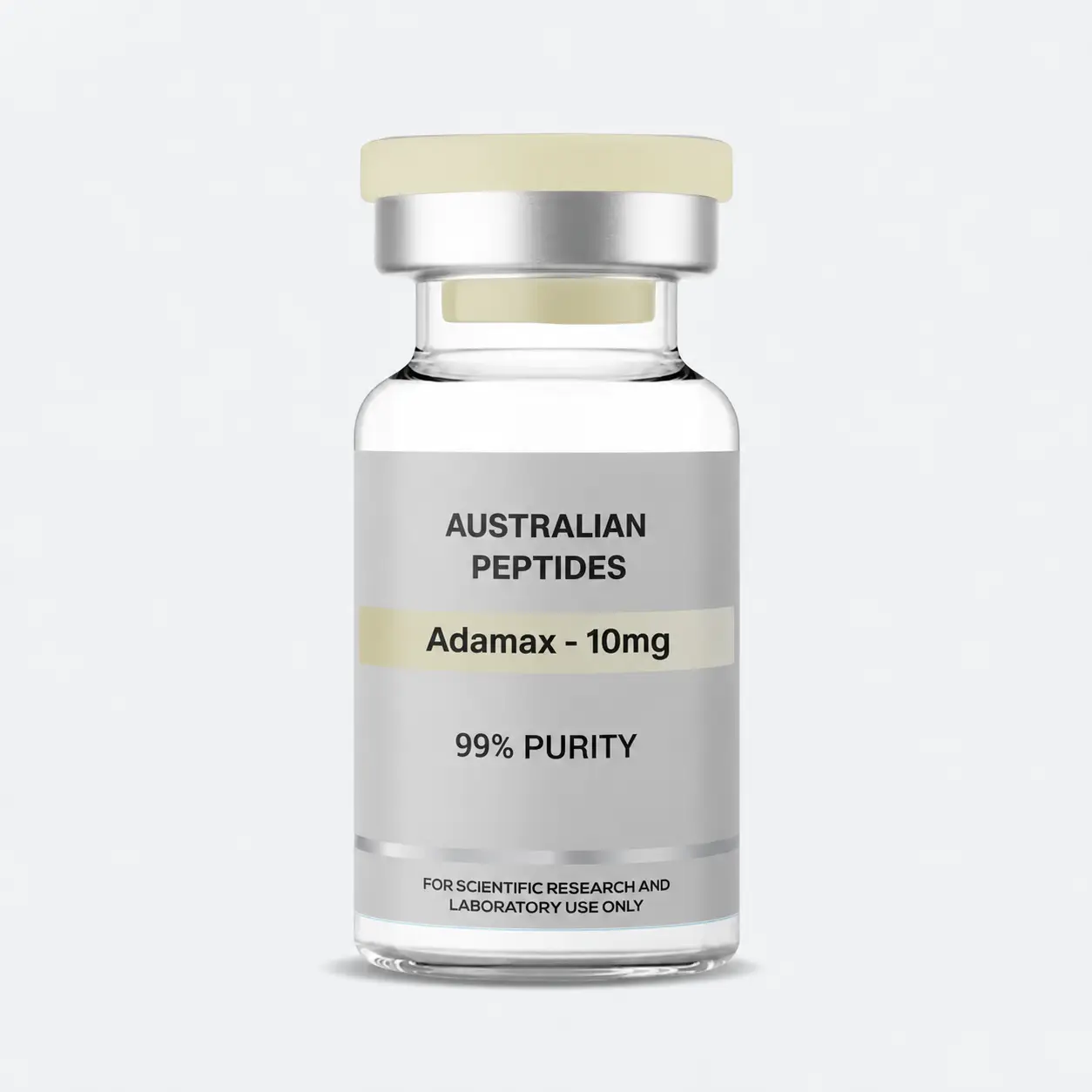
Adamax 10mg is an experimental peptide material commonly associated with Semax-related peptide modification, molecular stability and neuropeptide research.
Available from Peps Aussie Australia for controlled laboratory research and analytical applications.
For laboratory research use only. Not intended for human or animal consumption, administration, cognitive enhancement or therapeutic use.
Free Delivery on all orders above $320
Out of stock
Adamax 10mg is an experimental peptide reference material listed by Peps Aussie Australia for scientific investigation, laboratory analysis and controlled research applications.
Adamax is a commercial name generally associated with a proposed modification of Semax, a synthetic peptide investigated in neurobiology and neuropeptide signalling research.
The designation Adamax has appeared in discussions of peptide modification, molecular stability and experimental neuropeptide chemistry.
However, Adamax does not have a consistently established molecular identity across available commercial descriptions.
Its exact amino acid sequence, terminal modifications, chemical structure and relationship to Semax must be confirmed through appropriate product-specific documentation.
Scientific research involving Semax and other neuropeptides has examined neuronal signalling, gene expression and experimental cellular responses.
These findings do not establish that Adamax has equivalent biological activity or that any proposed molecular modification improves its performance.
Direct peer-reviewed efficacy and safety evidence involving a clearly characterised Adamax molecule has not been established.
Peps Aussie lists Adamax in a nominal 10mg size for laboratory research and analytical applications.
Important: Adamax is intended strictly for laboratory research and analytical purposes. It is not supplied for human or animal consumption, injection, nasal administration, cognitive enhancement, therapeutic use or clinical treatment.
Adamax is a commercial designation generally associated with an experimental Semax-related peptide modification.
Semax is a synthetic heptapeptide derived from a region of adrenocorticotropic hormone (ACTH).
The commonly referenced Semax sequence is:
Met–Glu–His–Phe–Pro–Gly–Pro (MEHFPGP)
Adamax is often discussed in connection with modifications intended to investigate peptide characteristics such as stability and molecular behaviour.
However, the designation alone does not establish:
These characteristics must be confirmed before meaningful conclusions can be drawn about the supplied material.
Semax has been investigated in experimental neurobiology because of its relationship to ACTH-derived peptide sequences.
Research involving Semax has examined topics including:
These investigations provide a broader scientific context for discussions of Semax-related peptide modifications.
However, published findings involving Semax cannot automatically be attributed to Adamax.
Scientific interest in Adamax primarily relates to proposed peptide modifications, analytical chemistry and the broader field of neuropeptide research.
Because the molecular identity and direct evidence base for Adamax remain uncertain, the following sections describe relevant scientific research topics rather than demonstrated Adamax-specific biological effects.
Synthetic peptide modifications are investigated to understand how molecular structure influences chemical and biological characteristics.
Research involving modified peptides may examine:
These investigations are relevant to evaluating proposed Semax-related derivatives.
However, a modification cannot be assumed to improve a peptide’s properties without direct analytical and experimental evidence.
Adamax is commonly discussed in relation to Semax.
Semax itself has been investigated in experimental neurobiology and peptide pharmacology.
Relevant research topics include:
The relevance of these findings to Adamax depends on the exact molecular relationship between the compounds.
A commercial description identifying Adamax as a Semax derivative is not sufficient to establish equivalent biological activity.
Peptide stability is an important consideration in laboratory research.
Synthetic peptides may undergo chemical or enzymatic degradation depending on their structure and environmental conditions.
Research topics include:
Proposed modifications to a Semax-related sequence may be investigated for their effects on stability.
However, no specific stability improvement should be claimed for Adamax without direct comparative testing.
Neuropeptides are short chains of amino acids involved in communication and regulation within biological systems.
Research involving experimental neuropeptides has examined:
These research areas provide background context for the proposed scientific interest in Adamax.
They do not demonstrate that Adamax produces particular neurological or behavioural effects.
Certain neuropeptides, including Semax, have been investigated in experimental models involving neurotrophic-associated signalling.
Neurotrophic factors are proteins involved in neuronal development, maintenance and cellular responses.
Relevant research topics include:
These topics are relevant to the broader literature on Semax.
However, there is insufficient direct evidence to establish that Adamax influences BDNF, NGF or related pathways in the same manner.
The biological behaviour of a peptide can depend strongly on its amino acid sequence and molecular structure.
Even relatively small structural modifications may influence:
For Adamax, establishing the exact chemical structure is a prerequisite for meaningful structure–activity research.
Researchers should avoid drawing conclusions based solely on the commercial name.
Adamax and Semax are related terms in commercial peptide discussions but should not be treated as interchangeable.
Semax:
Adamax:
Claims that Adamax is stronger, longer lasting or more effective than Semax are not established by the information available for this listing.
Analytical characterisation is especially important for research materials sold under commercial names that do not correspond to a consistently defined chemical structure.
Laboratories evaluating Adamax may investigate:
Analytical techniques may include high-performance liquid chromatography (HPLC), mass spectrometry (MS) and other suitable methods.
A chromatographic purity result alone does not establish that the material has the molecular structure claimed by a commercial product name.
Peps Aussie lists Adamax in a nominal 10mg size.
| Specification | Details |
|---|---|
| Product name | Adamax |
| Listed size | 10mg |
| Material type | Experimental peptide |
| Commercial research association | Proposed Semax-related peptide modification |
| Related research peptide | Semax |
| Exact amino acid sequence | Requires verification |
| Molecular modifications | Requires verification |
| Molecular mass | Requires verification |
| Research category | Peptide chemistry and experimental neuropeptide research |
| Research areas | Peptide modification, stability and neuropeptide signalling |
| Supplier | Peps Aussie Australia |
| Intended use | Laboratory research and analytical investigation only |
The scientific characteristics above describe the proposed research context associated with Adamax. They do not independently verify the identity, composition, purity or content of the supplied material.
Exact molecular identity, amino acid sequence, terminal modifications, salt form, formulation, physical appearance, fill quantity and excipients should be confirmed against the applicable product label and supporting lot documentation.
Important: Because Adamax does not have a consistently established molecular definition, the supplier’s chemical specification and supporting analytical records are particularly important.
Analytical verification is essential when evaluating experimental peptide materials with uncertain or inconsistently described molecular identities.
Peps Aussie maintains a dedicated resource where researchers can review available Certificates of Analysis and supporting analytical records.
View Peps Aussie Certificates of Analysis
When evaluating Adamax analytical documentation, researchers should consider:
High-performance liquid chromatography and mass spectrometry may support peptide characterisation.
However, a general purity result does not independently establish the exact molecular identity of Adamax.
A certificate should be interpreted according to the tests actually performed.
The availability of a certificate does not automatically establish sterility, endotoxin status, a particular purity percentage, pharmaceutical-grade manufacturing or independent verification of every production batch.
Experimental peptides require appropriate handling to support sample integrity and experimental reproducibility.
Storage requirements for Adamax depend on its exact molecular structure, formulation, packaging and validated manufacturer stability information.
Laboratories should consider:
No universal storage temperature or reconstitution procedure is recommended without verified product-specific documentation.
Because the exact structure of Adamax may differ between commercial descriptions, storage assumptions based on Semax should not automatically be applied.
All laboratory work should be performed by appropriately qualified personnel using validated procedures and suitable safety controls.
Peps Aussie maintains an Australian-based catalogue of research peptides and laboratory materials for scientific and analytical applications.
Adamax 10mg is the currently listed nominal product size.
Pricing and ordering availability should be confirmed through the product selection area. Inventory is currently pending confirmation.
For current information regarding Australian dispatch, delivery arrangements, processing times and applicable restrictions, visit the Peps Aussie Shipping Policy.
Adamax is a commercial peptide designation generally associated with a proposed Semax-related modification. Its exact molecular identity must be established through product-specific documentation.
The proposed research context involves peptide modification, molecular stability and experimental neuropeptide signalling.
No equivalence should be assumed. Adamax is commonly described as Semax-related, but its exact structure and biological characteristics require independent verification.
A universally established Adamax sequence cannot be confirmed from the product name alone. Researchers should consult the supplier’s molecular specification and applicable analytical records.
Adamax is sometimes discussed in commercial contexts involving nootropic research. However, there is insufficient direct evidence to establish cognitive-enhancing effects or clinical suitability.
There is insufficient direct comparative evidence to establish that Adamax is stronger, more effective or longer lasting than Semax.
Some Semax research has examined neurotrophic-associated pathways, including BDNF. These findings cannot automatically be attributed to Adamax.
Direct peer-reviewed clinical evidence involving a clearly characterised Adamax molecule has not been established for this listing.
Peps Aussie lists Adamax in a 10mg nominal size. Researchers should verify the individual vial label and supporting analytical documentation.
Available analytical documentation can be reviewed through the Peps Aussie Certificates of Analysis page. Researchers should confirm that any applicable certificate corresponds to the specific production lot and evaluate the tests performed.
Storage requirements depend on the molecular structure, formulation and validated stability characteristics. Follow the manufacturer’s product-specific documentation and established laboratory procedures.
No medical or veterinary approval is claimed for the Peps Aussie Adamax research product.
This product is not supplied for human or animal consumption, administration, diagnosis, prevention or treatment.
Peps Aussie maintains a catalogue of laboratory research peptides and scientific materials for researchers investigating molecular biology, peptide chemistry and experimental neurobiology.
Adamax is associated with research discussions involving Semax-related peptide modifications, molecular stability and neuropeptide signalling.
Researchers evaluating Adamax 10mg should prioritise accurate molecular identification, confirmation of chemical modifications, appropriate analytical documentation, batch traceability and validated laboratory procedures.
Explore the Peps Aussie research catalogue at pepsaussie.com.
Adamax 10mg is intended strictly for laboratory research and analytical purposes only.
This product is not intended for human or animal consumption, injection, nasal administration, cognitive enhancement, therapeutic use or clinical treatment.
Descriptions of published scientific research are provided for educational and informational purposes only. They do not establish improved cognition, neuroprotection, enhanced stability, clinical safety or therapeutic suitability for the material offered.
Findings involving Semax or other neuropeptides should not be assumed to apply to Adamax without direct supporting evidence.
No dosing, self-administration or therapeutic guidance is provided.
| Size | 10mg |
|---|
Reviews here are by invitation. We email a link once your order has arrived, so every review comes from someone who received the product. Lost the email? Find your review link.

Subscribe and we email you a single-use discount code. After that: new batch certificates as they are published, and restock alerts.

Reviews
There are no reviews yet.