
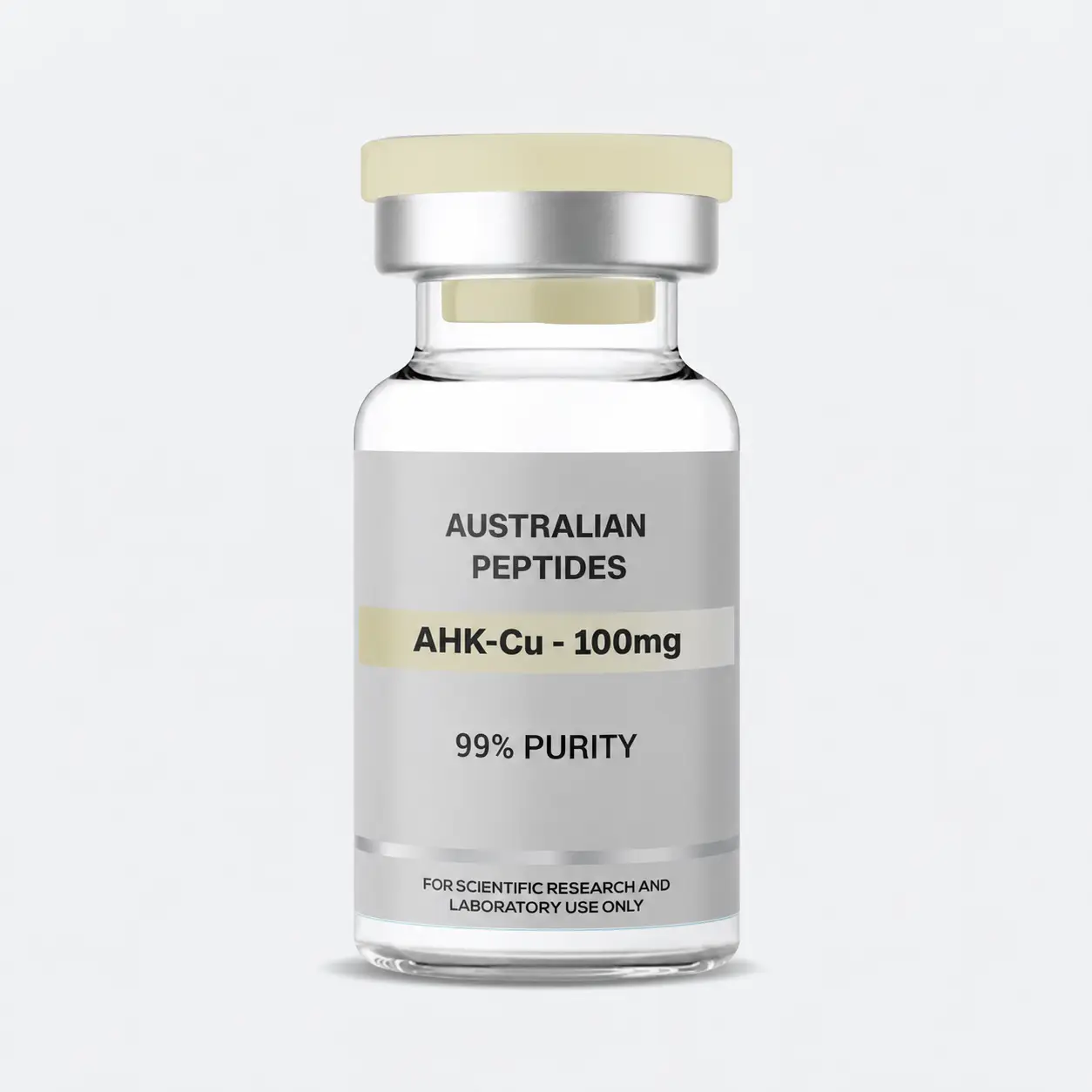
$65.00
AHK-Cu 100mg is a copper-binding tripeptide complex associated with hair-follicle biology, extracellular matrix signalling and experimental copper-peptide research.
Available from Peps Aussie Australia for controlled laboratory research and analytical applications.
For laboratory research use only. Not intended for human or animal consumption, topical application, administration or therapeutic use.
Free Delivery on all orders above $320
Out of stock
AHK-Cu 100mg is a copper-binding tripeptide complex listed by Peps Aussie Australia as reference material for scientific investigation, laboratory analysis and controlled experimental research.
AHK-Cu is associated with the tripeptide Alanine–Histidine–Lysine (AHK) and its ability to coordinate copper ions.
Copper-binding peptides have attracted scientific interest because of their relevance to coordination chemistry, extracellular matrix biology and cellular signalling.
Experimental research involving AHK-Cu has explored aspects of hair-follicle biology, cellular proliferation and responses associated with copper-peptide complexes.
However, published evidence remains limited, and findings from laboratory models do not establish that commercially supplied AHK-Cu produces clinically meaningful hair growth, skin rejuvenation or tissue repair.
AHK-Cu is chemically distinct from GHK-Cu, another copper-binding tripeptide commonly discussed in peptide research.
Peps Aussie lists AHK-Cu in a nominal 100mg size for laboratory research and analytical applications.
Important: AHK-Cu is intended strictly for laboratory research and analytical purposes. It is not supplied for human or animal consumption, injection, topical application, cosmetic use, therapeutic use or clinical treatment.
AHK-Cu is a copper-coordinating peptide complex associated with the amino acid sequence:
Alanine–Histidine–Lysine (Ala–His–Lys, AHK)
A tripeptide consists of three amino acid residues connected by peptide bonds.
The AHK sequence contains a histidine residue that can participate in interactions with metal ions, including copper.
Copper coordination can influence the physicochemical properties of peptide materials and their behaviour in experimental systems.
The exact characteristics of an AHK-Cu preparation depend on factors including:
The designation AHK-Cu alone does not independently establish every characteristic of a supplied complex.
Copper is an essential trace element involved in numerous biological processes.
It participates in the activity of certain enzymes and contributes to cellular redox chemistry.
Copper-binding peptides are studied because peptide sequences can influence how copper ions are coordinated and presented within a chemical or biological environment.
Research involving copper-peptide complexes has examined:
The presence of copper in a peptide complex does not automatically establish beneficial biological activity.
Published and experimental research involving AHK-Cu and related copper-peptide systems spans several areas of molecular biology, peptide chemistry and cellular signalling.
The following sections describe scientific research topics rather than proven therapeutic effects of the Peps Aussie material.
One of the areas associated with AHK-Cu research is hair-follicle biology.
Hair follicles are complex structures involving interactions between epithelial cells, dermal papilla cells and surrounding connective tissues.
Experimental studies involving AHK-Cu have investigated certain cellular responses relevant to hair-follicle research.
Relevant topics include:
These investigations contribute to understanding hair-follicle physiology.
However, observations from cell cultures or isolated follicles do not establish that AHK-Cu reverses hair loss or promotes clinically meaningful hair growth in humans.
Dermal papilla cells are specialised cells involved in signalling within the hair follicle.
They interact with surrounding cells and participate in the regulation of follicular biology.
Research involving AHK-Cu has examined cellular responses associated with dermal papilla models.
Relevant scientific topics include:
Findings from these systems must be interpreted within the limitations of the experimental model.
The extracellular matrix is a network of proteins and other molecules that provides structural and biochemical support to cells.
Copper-associated pathways are relevant to several aspects of extracellular matrix biology.
Research involving copper peptides and related systems has examined:
These investigations contribute to understanding how peptide and metal-ion interactions may influence cellular environments.
They do not establish that AHK-Cu repairs tissue or improves skin appearance in humans.
AHK-Cu is relevant to the study of peptide–metal interactions.
Peptides containing suitable functional groups can coordinate metal ions under specific chemical conditions.
Relevant research topics include:
These investigations are particularly relevant to analytical characterisation of copper-peptide materials.
Some experimental investigations involving AHK-Cu have examined cellular responses associated with growth and proliferation.
Relevant research areas include:
Changes in cell proliferation under laboratory conditions do not necessarily indicate beneficial effects in living organisms.
The biological significance of these observations depends on the cell type, experimental conditions and reproducibility of the results.
Copper participates in numerous biochemical processes, including certain oxidation–reduction reactions.
Copper-containing compounds can behave differently depending on their chemical environment.
Research topics include:
Copper is biologically essential but can also contribute to unwanted oxidative reactions under some conditions.
Therefore, the presence of copper in AHK-Cu should not be interpreted as inherently protective or beneficial.
AHK-Cu and GHK-Cu are both copper-binding tripeptide complexes, but they are structurally distinct.
AHK-Cu:
GHK-Cu:
Although both peptides contain histidine and lysine residues, the difference in their first amino acid residue means they are not chemically identical.
Research findings involving GHK-Cu should not automatically be attributed to AHK-Cu.
AHK-Cu is also relevant to analytical investigations involving peptide identity, metal coordination and material quality.
Laboratories evaluating AHK-Cu may investigate:
Analytical techniques may include chromatography, mass spectrometry and suitable methods for elemental or metal-content analysis.
A peptide purity result alone may not fully characterise the copper coordination or total composition of an AHK-Cu preparation.
Peps Aussie lists AHK-Cu in a nominal 100mg size.
| Specification | Details |
|---|---|
| Product name | AHK-Cu |
| Listed size | 100mg |
| Peptide type | Copper-binding tripeptide complex |
| Associated peptide sequence | Alanine–Histidine–Lysine (AHK) |
| Amino acid length | 3 residues |
| Metal component | Copper |
| Research category | Copper-peptide and cellular biology research |
| Research areas | Hair-follicle biology, extracellular matrix signalling and peptide coordination chemistry |
| Related research compound | GHK-Cu (chemically distinct) |
| Supplier | Peps Aussie Australia |
| Intended use | Laboratory research and analytical investigation only |
The scientific characteristics above describe AHK-Cu as discussed in research literature. They do not independently verify the identity, composition, purity or content of the supplied material.
Exact molecular identity, copper coordination state, peptide-to-metal ratio, salt form, formulation, physical appearance, fill quantity and excipients should be confirmed against the applicable product label and supporting lot documentation.
The nominal 100mg label should also be checked to determine whether it refers to the total copper-peptide complex or another defined basis of measurement.
Analytical verification is particularly important when evaluating copper-binding peptide complexes.
Peps Aussie maintains a dedicated resource where researchers can review available Certificates of Analysis and supporting analytical records.
View Peps Aussie Certificates of Analysis
When evaluating AHK-Cu analytical documentation, researchers should consider:
High-performance liquid chromatography and mass spectrometry may support peptide characterisation, while additional techniques may be needed to evaluate copper content and coordination.
A certificate should be interpreted according to the tests actually performed.
The availability of a certificate does not automatically establish sterility, endotoxin status, a particular purity percentage, pharmaceutical-grade manufacturing or independent verification of every production batch.
Copper-peptide complexes require appropriate handling to support sample integrity and experimental reproducibility.
Storage requirements for AHK-Cu depend on the molecular structure, copper coordination characteristics, formulation, packaging and validated manufacturer stability information.
Laboratories should consider:
No universal storage temperature or reconstitution procedure is recommended without verified product-specific documentation.
All laboratory work should be performed by appropriately qualified personnel using validated procedures and suitable safety controls.
Peps Aussie maintains an Australian-based catalogue of research peptides and laboratory materials for scientific and analytical applications.
AHK-Cu 100mg is the currently listed nominal product size.
Pricing and ordering availability should be confirmed through the product selection area. Inventory is currently pending confirmation.
For current information regarding Australian dispatch, delivery arrangements, processing times and applicable restrictions, visit the Peps Aussie Shipping Policy.
AHK-Cu is a copper-binding tripeptide complex associated with the amino acid sequence Alanine–Histidine–Lysine.
Experimental research has examined AHK-Cu in relation to hair-follicle biology, cellular proliferation and copper-peptide signalling.
No. AHK-Cu and GHK-Cu are chemically distinct tripeptide complexes. AHK contains alanine, while GHK contains glycine as its first amino acid residue.
AHK is the abbreviation for Alanine–Histidine–Lysine, a tripeptide consisting of three amino acid residues.
Preliminary laboratory investigations have examined AHK-Cu in hair-follicle-related models. These findings do not establish that commercially supplied AHK-Cu promotes human hair growth or treats hair loss.
Yes. AHK-Cu refers to a copper-coordinating complex associated with the AHK tripeptide.
Research involving copper-peptide systems has examined extracellular matrix biology and cellular signalling. However, this does not establish skin-repair or cosmetic benefits from AHK-Cu.
There is insufficient comparative clinical evidence to establish that AHK-Cu is superior to GHK-Cu for any human application.
Copper can coordinate with suitable functional groups within peptides, influencing the chemical characteristics of the resulting complex.
Its specific biological behaviour depends on the molecular structure and experimental conditions.
Peps Aussie lists AHK-Cu in a 100mg nominal size. Researchers should verify the individual vial label and supporting analytical documentation.
Available analytical documentation can be reviewed through the Peps Aussie Certificates of Analysis page. Researchers should confirm that any applicable certificate corresponds to the specific production lot and evaluate the tests performed.
Storage requirements depend on the molecular structure, formulation and validated stability characteristics. Follow the manufacturer’s product-specific documentation and established laboratory procedures.
No medical or veterinary approval is claimed for the Peps Aussie AHK-Cu research product.
This product is not supplied for human or animal consumption, topical application, administration, diagnosis, prevention or treatment.
Peps Aussie maintains a catalogue of laboratory research peptides and scientific materials for researchers investigating molecular biology, peptide chemistry and cellular signalling.
AHK-Cu remains a subject of scientific interest because of its copper-binding characteristics and its association with experimental hair-follicle and extracellular matrix research.
Researchers evaluating AHK-Cu 100mg should prioritise accurate molecular identification, appropriate copper-complex characterisation, analytical documentation, batch traceability and validated laboratory procedures.
Explore the Peps Aussie research catalogue at pepsaussie.com.
AHK-Cu 100mg is intended strictly for laboratory research and analytical purposes only.
This product is not intended for human or animal consumption, injection, topical application, cosmetic use, therapeutic use or clinical treatment.
Descriptions of published scientific research are provided for educational and informational purposes only. They do not establish hair-growth benefits, skin rejuvenation, tissue repair, clinical safety or therapeutic suitability for the material offered.
Findings involving GHK-Cu or other copper-peptide complexes should not be assumed to apply to AHK-Cu without direct supporting evidence.
No dosing, self-administration or therapeutic guidance is provided.
| Size | 100mg |
|---|
Reviews here are by invitation. We email a link once your order has arrived, so every review comes from someone who received the product. Lost the email? Find your review link.

Subscribe and we email you a single-use discount code. After that: new batch certificates as they are published, and restock alerts.

Reviews
There are no reviews yet.