
$220.00
Free Delivery on all orders above $320
Out of stock
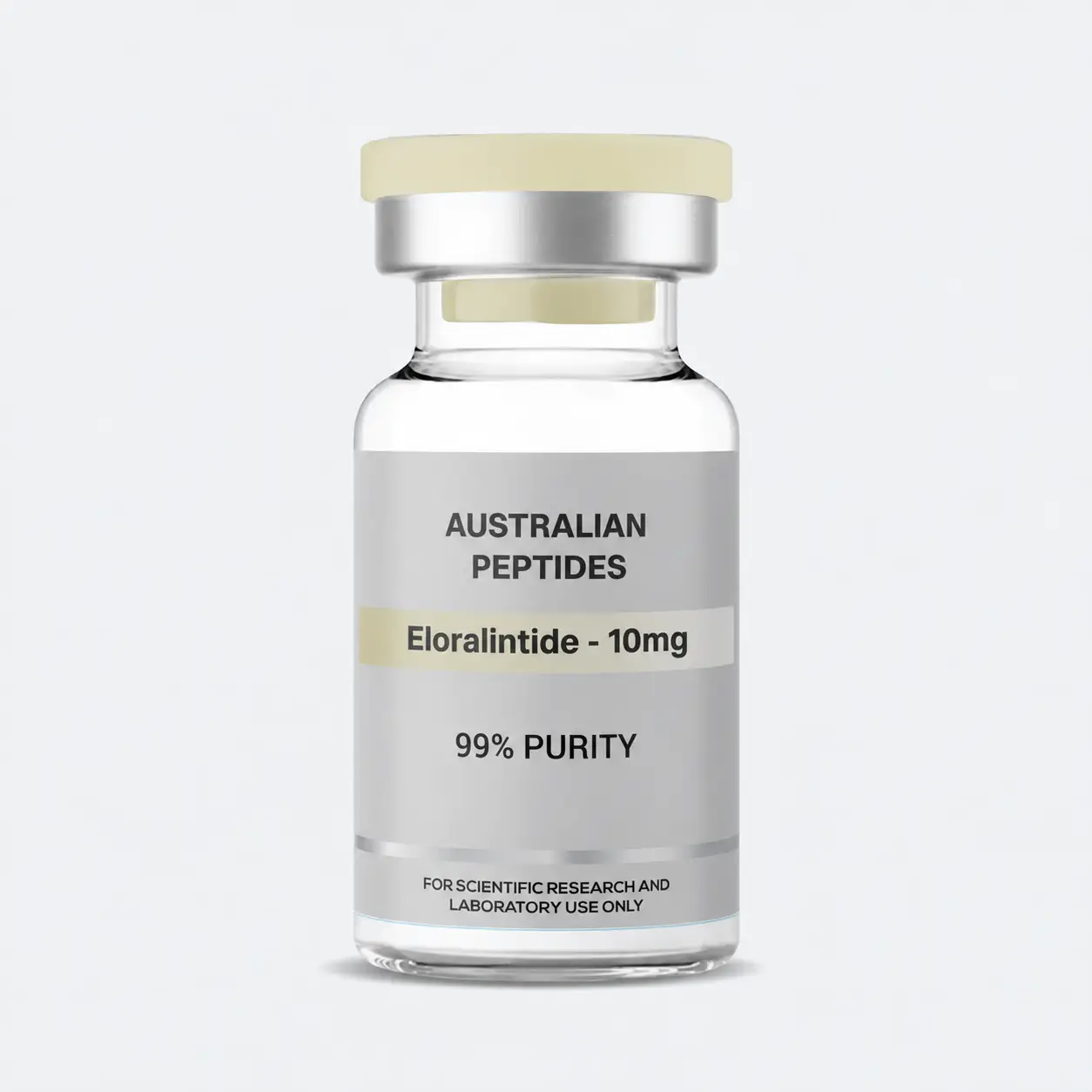
Eloralintide 10mg, also identified by the development code LY3841136, is an investigational amylin-receptor agonist listed by Peps Aussie Australia as reference material for scientific investigation, laboratory analysis and controlled experimental research.
Eloralintide has attracted scientific interest because of its reported long-acting pharmacological characteristics and preferential activity at the AMY1 receptor in laboratory assays.
Amylin is a peptide hormone involved in metabolic signalling and the regulation of physiological processes associated with food intake and nutrient handling.
Amylin receptors belong to a family of receptor complexes formed through interactions between the calcitonin receptor and receptor activity-modifying proteins.
Experimental research involving Eloralintide has examined receptor pharmacology, signalling selectivity, pharmacokinetic characteristics and metabolic endpoints.
Early clinical development has also investigated tolerability and selected metabolic outcomes using specifically manufactured investigational drug material.
However, Eloralintide remains an investigational compound, and clinical trial results do not establish the identity, composition, safety or efficacy of material supplied by an unrelated source.
The characteristics of any research preparation must be independently established through appropriate product-specific analytical documentation.
Peps Aussie lists Eloralintide in a nominal 10mg size for laboratory research and analytical applications.
Important: Eloralintide is intended strictly for laboratory research and analytical purposes. It is not supplied for human or animal consumption, injection, administration, weight management, therapeutic use or clinical treatment.
Eloralintide (LY3841136) is an investigational long-acting amylin-receptor agonist.
It has been studied for its interactions with amylin receptor complexes, particularly the AMY1 receptor.
Amylin receptors are formed through interactions between the calcitonin receptor and receptor activity-modifying proteins, commonly abbreviated as RAMPs.
The three principal amylin receptor subtypes are:
These receptor complexes can differ in their pharmacological responses to peptide ligands.
Eloralintide has demonstrated preferential activity at AMY1 in reported experimental assays.
However, receptor selectivity depends on the assay system, receptor expression and experimental conditions.
Amylin is a peptide hormone co-secreted with insulin by pancreatic beta cells.
It participates in physiological signalling associated with nutrient intake and metabolic regulation.
Research involving amylin and related receptor agonists has examined:
These areas provide the scientific context for Eloralintide research.
Published research involving Eloralintide and related amylin-receptor agonists spans several areas of receptor pharmacology, metabolic biology and investigational drug development.
The following sections describe scientific research topics rather than proven therapeutic effects of the Peps Aussie material.
One of the principal areas associated with Eloralintide research involves its reported preferential activity at the AMY1 receptor.
AMY1 is a receptor complex formed by the calcitonin receptor and RAMP1.
Experimental investigations have examined how amylin-related ligands interact with different receptor subtypes.
Relevant research topics include:
These investigations contribute to understanding the pharmacological characteristics of amylin-receptor agonists.
Amylin receptors belong to a broader family of G protein-coupled receptor complexes.
Their activation can influence intracellular signalling pathways.
Research involving amylin-receptor agonists has examined:
These investigations contribute to understanding the molecular behaviour of amylin-related compounds.
However, receptor activation observed in laboratory assays does not independently establish clinical efficacy.
Amylin participates in physiological processes associated with nutrient handling and metabolic regulation.
Experimental investigations involving amylin-receptor agonists have examined how receptor activation relates to metabolic signalling.
Relevant research topics include:
These investigations provide context for understanding Eloralintide’s proposed research applications.
They do not establish that independently supplied Eloralintide material improves metabolic health in humans.
Amylin signalling is relevant to the physiological regulation of food intake.
Research involving amylin-receptor agonists has examined pathways associated with satiety and energy balance.
Relevant scientific topics include:
Clinical studies involving investigational amylin-receptor agonists have also examined body-weight-related endpoints.
However, trial findings cannot be extrapolated to research materials of unverified identity or composition.
Eloralintide has been developed as a long-acting investigational compound.
Pharmacokinetic research examines how compounds are distributed, transformed and eliminated within experimental systems.
Relevant research topics include:
These investigations are relevant to understanding the characteristics of investigational peptide therapeutics.
However, the term long-acting does not establish a specific duration of activity for an independently supplied research preparation.
Eloralintide has been investigated in early clinical development using specifically characterised investigational drug material.
Clinical research may examine:
Such investigations contribute to the development of scientific knowledge about the investigational compound.
However, early clinical findings do not establish broad therapeutic approval or an accepted safety profile.
They also do not validate the quality or clinical suitability of material supplied by an unrelated manufacturer.
Eloralintide is sometimes discussed alongside other investigational amylin-receptor agonists.
However, these compounds should not be treated as interchangeable.
Eloralintide (LY3841136):
Cagrilintide:
Pramlintide:
Research findings involving one amylin-receptor agonist should not automatically be attributed to another.
Eloralintide is also relevant to analytical investigations involving peptide identity, molecular structure and material quality.
Laboratories evaluating Eloralintide may investigate:
Analytical techniques may include high-performance liquid chromatography (HPLC), mass spectrometry (MS) and other suitable methods.
A chromatographic purity result alone does not establish that a research material is chemically equivalent to the investigational compound used in published clinical trials.
Peps Aussie lists Eloralintide in a nominal 10mg size.
| Specification | Details |
|---|---|
| Product name | Eloralintide |
| Development code | LY3841136 |
| Listed size | 10mg |
| Material type | Investigational peptide research material |
| Research classification | Amylin-receptor agonist |
| Reported receptor preference | AMY1 |
| Research category | Receptor pharmacology and metabolic signalling |
| Research areas | Amylin receptor biology, pharmacokinetics and metabolic endpoints |
| Exact molecular structure | Requires verification against supplier documentation |
| Supplier | Peps Aussie Australia |
| Intended use | Laboratory research and analytical investigation only |
The scientific characteristics above describe Eloralintide as discussed in published research. They do not independently verify the identity, composition, purity or content of the supplied material.
Exact molecular identity, amino acid sequence, molecular modifications, salt form, formulation, physical appearance, fill quantity and excipients should be confirmed against the applicable product label and supporting lot documentation.
Important: The name Eloralintide or development code LY3841136 does not independently establish that an unrelated research preparation is identical to the material used in clinical trials.
Analytical verification is particularly important when evaluating research materials associated with investigational pharmaceutical compounds.
Peps Aussie maintains a dedicated resource where researchers can review available Certificates of Analysis and supporting analytical records.
View Peps Aussie Certificates of Analysis
When evaluating Eloralintide analytical documentation, researchers should consider:
High-performance liquid chromatography and mass spectrometry may support peptide characterisation.
However, a general purity result does not independently establish chemical equivalence to pharmaceutical investigational material.
A certificate should be interpreted according to the tests actually performed.
The availability of a certificate does not automatically establish sterility, endotoxin status, a particular purity percentage, pharmaceutical-grade manufacturing or independent verification of every production batch.
Investigational peptide materials require appropriate handling to support sample integrity and experimental reproducibility.
Storage requirements for Eloralintide depend on the molecular structure, formulation, packaging and validated manufacturer stability information.
Laboratories should consider:
No universal storage temperature or reconstitution procedure is recommended without verified product-specific documentation.
Storage or preparation information from clinical trial formulations should not automatically be applied to independently supplied research materials.
All laboratory work should be performed by appropriately qualified personnel using validated procedures and suitable safety controls.
Peps Aussie maintains an Australian-based catalogue of research peptides and laboratory materials for scientific and analytical applications.
Eloralintide 10mg is the currently listed nominal product size.
Pricing and ordering availability should be confirmed through the product selection area. Inventory is currently pending confirmation.
For current information regarding Australian dispatch, delivery arrangements, processing times and applicable restrictions, visit the Peps Aussie Shipping Policy.
Eloralintide, also known as LY3841136, is an investigational long-acting amylin-receptor agonist with reported preferential activity at the AMY1 receptor.
Published receptor studies and early clinical trials have examined Eloralintide’s pharmacology, tolerability, pharmacokinetic characteristics and metabolic endpoints.
Yes. LY3841136 is the development code associated with Eloralintide.
AMY1 is an amylin receptor complex formed through interactions between the calcitonin receptor and receptor activity-modifying protein 1 (RAMP1).
Eloralintide is primarily described as an investigational amylin-receptor agonist. It should not be classified as a GLP-1 receptor agonist without direct supporting pharmacological evidence.
No. Eloralintide and cagrilintide are distinct investigational amylin-receptor agonists with different molecular structures and development programmes.
Clinical research has investigated body-weight-related endpoints using specifically characterised investigational Eloralintide material. These findings do not establish clinical suitability or efficacy for an independently supplied research vial.
Yes. Eloralintide has entered clinical investigation. However, clinical trial findings apply to the specific investigational drug material studied and do not validate unrelated research preparations.
Eloralintide remains investigational in the context described here. No therapeutic approval is claimed for the Peps Aussie research product.
Peps Aussie lists Eloralintide in a 10mg nominal size. Researchers should verify the individual vial label and supporting analytical documentation.
Available analytical documentation can be reviewed through the Peps Aussie Certificates of Analysis page. Researchers should confirm that any applicable certificate corresponds to the specific production lot and evaluate the tests performed.
Storage requirements depend on the molecular structure, formulation and validated stability characteristics. Follow the manufacturer’s product-specific documentation and established laboratory procedures.
No medical or veterinary approval is claimed for the Peps Aussie Eloralintide research product.
This product is not supplied for human or animal consumption, administration, diagnosis, prevention or treatment.
Peps Aussie maintains a catalogue of laboratory research peptides and scientific materials for researchers investigating molecular biology, receptor pharmacology and metabolic signalling.
Eloralintide remains a subject of scientific interest because of its reported AMY1 receptor preference and its investigation in receptor pharmacology and early clinical development.
Researchers evaluating Eloralintide 10mg should prioritise accurate molecular identification, appropriate analytical documentation, batch traceability and validated laboratory procedures.
Explore the Peps Aussie research catalogue at pepsaussie.com.
Eloralintide 10mg is intended strictly for laboratory research and analytical purposes only.
This product is not intended for human or animal consumption, injection, administration, weight management, therapeutic use or clinical treatment.
Descriptions of published scientific research are provided for educational and informational purposes only. They do not establish weight-loss benefits, metabolic improvement, clinical safety or therapeutic suitability for the material offered.
Clinical trial findings involving specifically manufactured investigational Eloralintide do not establish the identity, quality or clinical suitability of independently supplied research material.
No dosing, self-administration or therapeutic guidance is provided.
| Size | 10mg |
|---|
Reviews here are by invitation. We email a link once your order has arrived, so every review comes from someone who received the product. Lost the email? Find your review link.

Subscribe and we email you a single-use discount code. After that: new batch certificates as they are published, and restock alerts.

Reviews
There are no reviews yet.