
$70.00
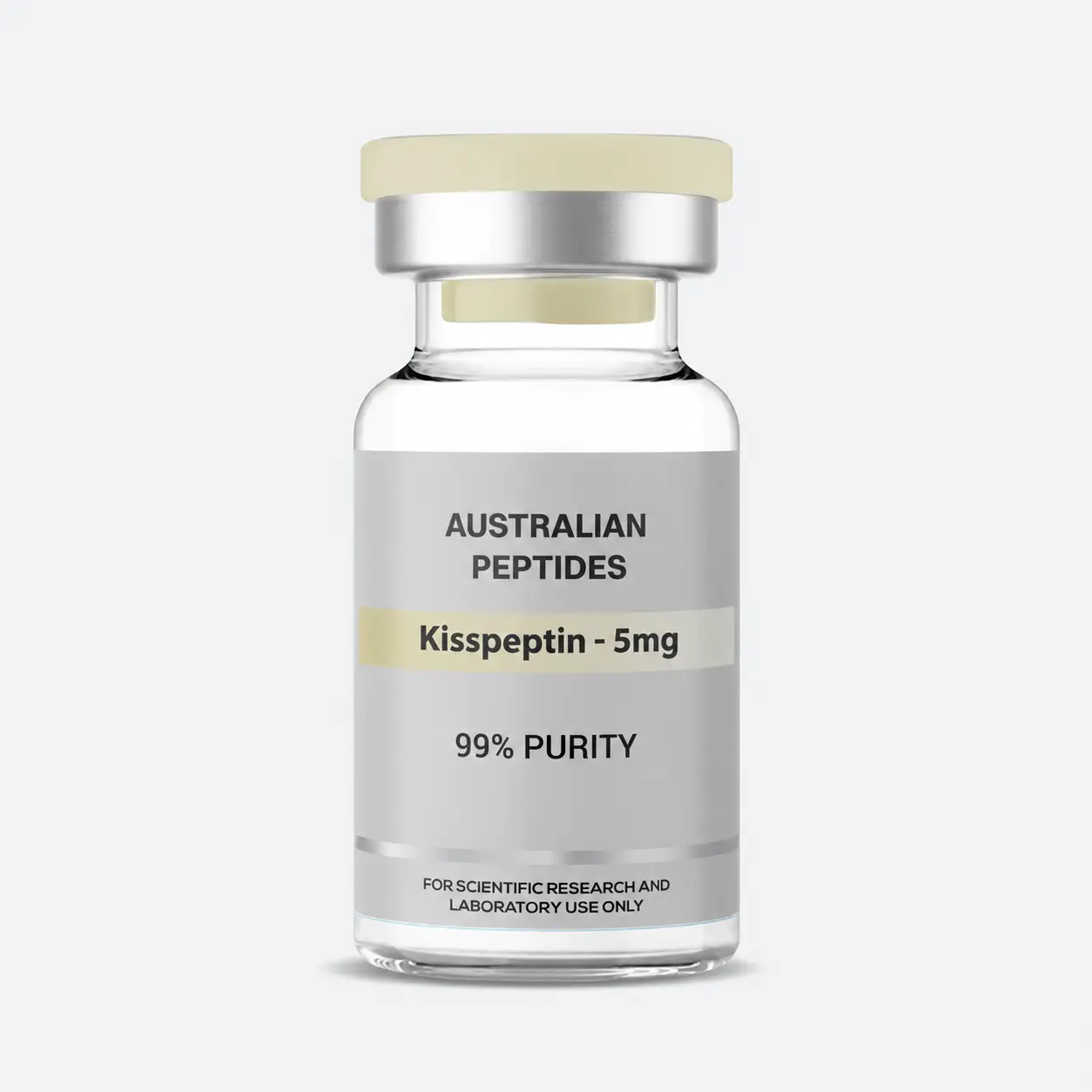
Kisspeptin 5mg is a peptide reference material associated with the KISS1 signalling system, investigated in KISS1R/GPR54 receptor pharmacology, GnRH regulation and reproductive endocrine research.
Available from Peps Aussie Australia for controlled laboratory research and analytical applications.
For laboratory research use only. Not intended for human or animal consumption, administration, fertility treatment or therapeutic use.
Free Delivery on all orders above $320
Out of stock
Kisspeptin 5mg is a peptide reference material listed by Peps Aussie Australia for scientific investigation, laboratory analysis and controlled experimental research.
Kisspeptins are a family of biologically active peptides derived from the KISS1 gene and associated with signalling through the kisspeptin receptor (KISS1R), also known as GPR54.
The kisspeptin signalling system has attracted substantial scientific interest because of its involvement in hypothalamic regulation of reproductive endocrine function.
Published research has examined kisspeptin-associated pathways in relation to gonadotropin-releasing hormone (GnRH) signalling, reproductive hormone regulation, neuroendocrine physiology and receptor pharmacology.
Kisspeptin signalling is particularly relevant to the hypothalamic–pituitary–gonadal (HPG) axis, a physiological system involved in regulating reproductive endocrine processes.
However, the term Kisspeptin refers to multiple related peptide fragments rather than a single molecular structure.
Different kisspeptin fragments may share receptor-related activity while differing in amino acid length, molecular mass, stability and experimental pharmacology.
For this reason, the exact peptide fragment supplied under the Kisspeptin 5mg listing must be confirmed before assigning a particular amino acid sequence or interpreting fragment-specific research findings.
Peps Aussie lists Kisspeptin in a nominal 5mg size for laboratory research and analytical applications.
Important: Kisspeptin is intended strictly for laboratory research and analytical purposes. It is not supplied for human or animal consumption, injection, administration, fertility treatment, hormone therapy, reproductive enhancement or clinical use.
Kisspeptin refers to a family of peptides produced through processing of the protein precursor encoded by the human KISS1 gene.
These peptides are involved in signalling through the kisspeptin receptor, commonly referred to as KISS1R or GPR54.
KISS1R is a G protein-coupled receptor associated with reproductive neuroendocrine regulation.
Kisspeptin signalling has been investigated extensively because of its relationship with hypothalamic GnRH neurons and the broader reproductive hormone axis.
Several kisspeptin fragments are described in scientific literature.
Kisspeptin-54
A 54-amino-acid peptide associated with the KISS1 signalling system. It has been investigated in reproductive endocrine and clinical research.
Kisspeptin-14
A shorter kisspeptin fragment containing 14 amino acid residues.
Kisspeptin-13
A 13-amino-acid kisspeptin fragment investigated in receptor-related research.
Kisspeptin-10
A shorter 10-amino-acid fragment containing a conserved C-terminal region important for kisspeptin receptor activity.
Although these fragments are related, they should not be assumed to have identical stability, pharmacokinetics or experimental effects.
The Peps Aussie 5mg listing does not specify which kisspeptin fragment is supplied. Researchers should verify the exact molecular identity through the applicable product documentation.
The kisspeptin receptor is a G protein-coupled receptor involved in cellular signalling.
KISS1R activation is associated with pathways relevant to reproductive neuroendocrine regulation.
Relevant research areas include:
These areas provide the scientific context for kisspeptin research.
Published research involving kisspeptins spans reproductive neuroendocrinology, receptor pharmacology, developmental biology and peptide chemistry.
The following sections describe scientific research topics rather than proven therapeutic effects of the Peps Aussie material.
One of the primary areas associated with kisspeptin research involves activation of the kisspeptin receptor.
KISS1R is a G protein-coupled receptor involved in signalling pathways associated with reproductive endocrine regulation.
Experimental studies involving kisspeptin fragments have examined receptor-mediated responses.
Relevant research topics include:
These investigations contribute to understanding the molecular characteristics of kisspeptin signalling.
However, receptor activity observed with one kisspeptin fragment should not automatically be attributed to another.
Gonadotropin-releasing hormone is a hypothalamic peptide hormone involved in regulating reproductive endocrine function.
GnRH participates in the control of pituitary gonadotropin secretion.
Kisspeptin signalling is an important component of the physiological systems that regulate GnRH neurons.
Relevant research topics include:
These investigations contribute to understanding the regulation of reproductive hormone signalling.
However, findings involving GnRH-associated pathways do not establish fertility benefits or clinical suitability for independently supplied research material.
The hypothalamic–pituitary–gonadal axis is a physiological system involved in regulating reproductive endocrine function.
It includes interactions between the hypothalamus, pituitary gland and gonads.
Kisspeptin signalling is relevant to several regulatory processes within this axis.
Relevant research topics include:
These investigations contribute to understanding reproductive endocrine physiology.
However, changes in hormone-associated measurements are not inherently beneficial and require careful interpretation.
Kisspeptin research has examined pathways associated with reproductive hormone regulation.
The relationship between kisspeptin signalling and GnRH neurons provides a basis for investigating downstream endocrine responses.
Relevant research topics include:
These investigations contribute to understanding the biological regulation of reproductive hormones.
However, published findings do not establish that the Peps Aussie material can safely or effectively modify hormone levels in humans.
The kisspeptin signalling system has been investigated in relation to reproductive maturation and puberty.
Genetic and physiological research has helped establish the importance of KISS1R-associated signalling in normal reproductive development.
Relevant research topics include:
These investigations contribute to understanding the biological processes associated with reproductive maturation.
However, developmental research findings do not establish therapeutic applications for independently supplied kisspeptin material.
Reproductive endocrine signalling is regulated through interactions between neural pathways, circulating hormones and feedback mechanisms.
Kisspeptin neurons participate in aspects of this regulatory system.
Relevant research topics include:
These investigations contribute to understanding how reproductive endocrine systems are regulated.
However, findings are influenced by experimental model, species, hormonal environment and peptide fragment.
Different kisspeptin fragments are frequently discussed together because they share a common biological origin.
However, they should not be considered interchangeable without supporting evidence.
Kisspeptin-10:
Kisspeptin-54:
Other Kisspeptin Fragments:
Research findings involving one fragment should not automatically be applied to another.
Analytical characterisation is particularly important when evaluating research materials described using a peptide family name.
Laboratories evaluating kisspeptin may investigate:
Analytical techniques may include high-performance liquid chromatography (HPLC), mass spectrometry (MS) and other suitable methods.
A chromatographic purity result alone does not establish which kisspeptin fragment is present.
Likewise, a product labelled simply as Kisspeptin should not automatically be identified as Kisspeptin-10 or Kisspeptin-54 without supporting analytical evidence.
Peps Aussie lists Kisspeptin in a nominal 5mg size.
| Specification | Details |
|---|---|
| Product name | Kisspeptin |
| Listed size | 5mg |
| Molecular category | KISS1-derived peptide family |
| Specific peptide fragment | Requires verification |
| Known research fragments | Kisspeptin-54, -14, -13 and -10 |
| Exact amino acid sequence | Requires verification |
| Primary receptor | Kisspeptin receptor (KISS1R/GPR54) |
| Research category | Reproductive neuroendocrine signalling |
| Research areas | GnRH regulation, KISS1R pharmacology and hypothalamic–pituitary–gonadal signalling |
| Supplier | Peps Aussie Australia |
| Intended use | Laboratory research and analytical investigation only |
The scientific characteristics above describe kisspeptins as discussed in published research. They do not independently verify the identity, composition, purity or content of the supplied material.
Exact peptide fragment, amino acid sequence, terminal modifications, salt form, formulation, physical appearance, fill quantity and excipients should be confirmed against the applicable product label and supporting lot documentation.
Important: The product name Kisspeptin does not independently establish whether the material is Kisspeptin-10, Kisspeptin-54 or another kisspeptin fragment.
Analytical verification is especially important when evaluating research materials associated with a family of related peptide fragments.
Peps Aussie maintains a dedicated resource where researchers can review available Certificates of Analysis and supporting analytical records.
View Peps Aussie Certificates of Analysis
When evaluating Kisspeptin analytical documentation, researchers should consider:
High-performance liquid chromatography and mass spectrometry are commonly used in peptide characterisation.
However, a general purity result does not independently establish the peptide fragment’s identity or amino acid sequence.
A certificate should be interpreted according to the tests actually performed.
The availability of a certificate does not automatically establish sterility, endotoxin status, a particular purity percentage, pharmaceutical-grade manufacturing or independent verification of every production batch.
Research peptides require appropriate handling to support sample integrity and experimental reproducibility.
Storage requirements for kisspeptin depend on the specific peptide fragment, molecular structure, formulation, packaging and validated manufacturer stability information.
Laboratories should consider:
No universal storage temperature or reconstitution procedure is recommended without verified product-specific documentation.
Because kisspeptin fragments differ in molecular structure, handling assumptions should not automatically be transferred between Kisspeptin-10, Kisspeptin-54 or other forms.
All laboratory work should be performed by appropriately qualified personnel using validated procedures and suitable safety controls.
Peps Aussie maintains an Australian-based catalogue of research peptides and laboratory materials for scientific and analytical applications.
Kisspeptin 5mg is the currently listed nominal product size.
Pricing and ordering availability should be confirmed through the product selection area. Inventory is currently pending confirmation.
For current information regarding Australian dispatch, delivery arrangements, processing times and applicable restrictions, visit the Peps Aussie Shipping Policy.
Kisspeptin refers to a family of peptides derived from the KISS1 precursor and associated with signalling through the KISS1 receptor, also known as GPR54.
Published research examines kisspeptin in relation to GnRH regulation, reproductive endocrine signalling, KISS1R receptor pharmacology and hypothalamic–pituitary–gonadal physiology.
No. Kisspeptin refers to multiple related peptide fragments, including Kisspeptin-54, Kisspeptin-14, Kisspeptin-13 and Kisspeptin-10.
The specific peptide fragment must be verified against the product label and supporting lot documentation. The 5mg label alone does not establish which fragment is supplied.
Kisspeptin peptides are associated with activation of the kisspeptin receptor, known as KISS1R or GPR54.
Kisspeptin signalling is involved in regulating hypothalamic GnRH neurons and associated reproductive endocrine pathways.
Yes. Research has examined kisspeptin-associated signalling in relation to GnRH, LH, FSH and broader reproductive endocrine regulation.
Yes. Kisspeptin and KISS1R signalling have been investigated in relation to reproductive maturation and developmental neuroendocrine regulation.
No. These are different peptide fragments with distinct molecular structures and potentially different pharmacokinetic characteristics.
The Peps Aussie research material is not supplied for fertility treatment. Published investigations of specific kisspeptin preparations do not establish fertility benefits, clinical safety or therapeutic suitability for this product.
No medical approval or clinical suitability is claimed for the Peps Aussie Kisspeptin research product.
Peps Aussie lists Kisspeptin in a 5mg nominal size. Researchers should verify the individual vial label and supporting analytical documentation.
Available analytical documentation can be reviewed through the Peps Aussie Certificates of Analysis page. Researchers should confirm that any applicable certificate corresponds to the specific production lot and identifies the relevant peptide fragment.
Storage requirements depend on the specific peptide fragment, formulation and validated stability characteristics. Follow the manufacturer’s product-specific documentation and established laboratory procedures.
No veterinary approval or clinical suitability is claimed for the Peps Aussie research product.
It is not supplied for animal consumption, administration, diagnosis, prevention or treatment.
Peps Aussie maintains a catalogue of laboratory research peptides and scientific materials for researchers investigating molecular biology, peptide chemistry and endocrine signalling.
Kisspeptin remains a subject of scientific interest because of its relationship with KISS1R receptor pharmacology, GnRH regulation and reproductive neuroendocrine pathways.
Researchers evaluating Kisspeptin 5mg should prioritise accurate identification of the specific peptide fragment, appropriate analytical documentation, batch traceability and validated laboratory procedures.
Explore the Peps Aussie research catalogue at pepsaussie.com.
Kisspeptin 5mg is intended strictly for laboratory research and analytical purposes only.
This product is not intended for human or animal consumption, injection, administration, fertility treatment, hormone therapy, reproductive enhancement, therapeutic use or clinical treatment.
Descriptions of published scientific research are provided for educational and informational purposes only. They do not establish fertility benefits, reproductive hormone optimisation, clinical safety or therapeutic suitability for the material offered.
Research findings involving specific kisspeptin fragments should not be assumed to apply to independently supplied material without verified molecular identity and direct supporting evidence.
No dosing, self-administration or therapeutic guidance is provided.
| Size | 5mg |
|---|
Reviews here are by invitation. We email a link once your order has arrived, so every review comes from someone who received the product. Lost the email? Find your review link.

Subscribe and we email you a single-use discount code. After that: new batch certificates as they are published, and restock alerts.

Reviews
There are no reviews yet.