
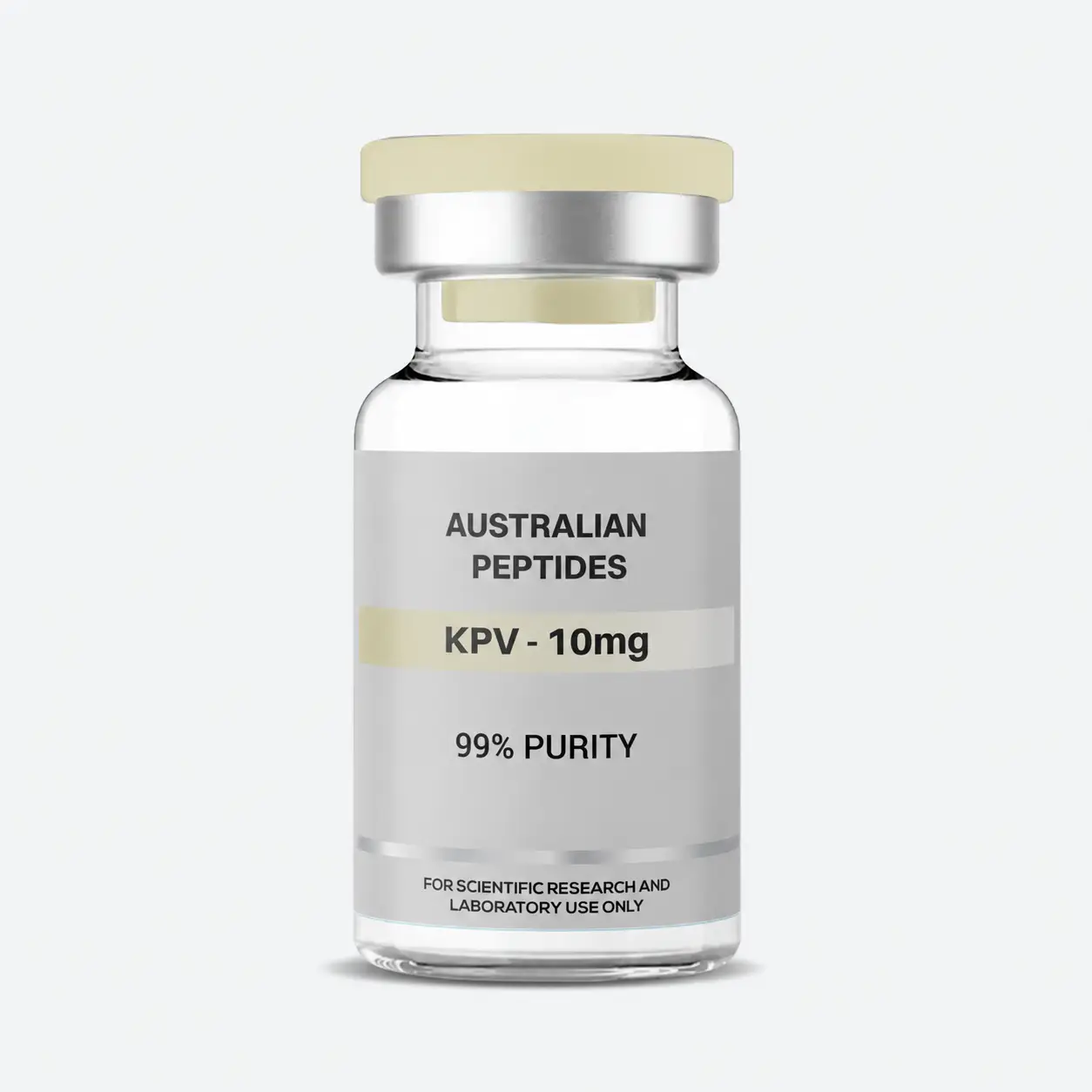
KPV 10mg & 20mg is a synthetic tripeptide derived from the C-terminal sequence of alpha-melanocyte-stimulating hormone (α-MSH), investigated in inflammatory signalling and epithelial research models.
Available from Peps Aussie Australia for controlled laboratory research and analytical applications.
For laboratory research use only. Not intended for human or animal consumption, administration, topical application or therapeutic use.
Free Delivery on all orders above $320
KPV 10mg & 20mg is a synthetic tripeptide reference material listed by Peps Aussie Australia for scientific investigation, laboratory analysis and controlled experimental research.
KPV is composed of three amino acid residues:
Lysine–Proline–Valine (Lys–Pro–Val)
The peptide corresponds to the C-terminal tripeptide sequence of alpha-melanocyte-stimulating hormone (α-MSH), a naturally occurring peptide involved in melanocortin signalling and other biological processes.
KPV has attracted scientific interest because experimental research has investigated its relationship with inflammatory signalling, epithelial cell biology and intestinal research models.
Published cell-based and animal studies have examined KPV in the context of cellular inflammatory responses, intestinal epithelial systems and molecular pathways associated with immune signalling.
However, these findings remain predominantly preclinical.
They do not establish that KPV is an approved anti-inflammatory treatment or that it produces clinically meaningful improvements in inflammatory, gastrointestinal or dermatological conditions.
KPV is structurally related to α-MSH but is not equivalent to the full-length hormone.
Peps Aussie lists KPV in nominal 10mg and 20mg sizes for laboratory research and analytical applications.
Important: KPV is intended strictly for laboratory research and analytical purposes. It is not supplied for human or animal consumption, injection, oral administration, topical application, therapeutic use or clinical treatment.
KPV is a synthetic tripeptide consisting of the amino acid sequence:
Lys–Pro–Val (KPV)
A tripeptide is a molecule composed of three amino acid residues connected by peptide bonds.
KPV is derived conceptually from the C-terminal region of alpha-melanocyte-stimulating hormone.
Alpha-MSH is a 13-amino-acid peptide associated with the proopiomelanocortin (POMC) system.
The parent peptide participates in several physiological signalling pathways, including melanocortin receptor biology.
KPV has been investigated as a smaller peptide fragment in experimental research involving inflammatory and epithelial responses.
Relevant research areas include:
These research topics contribute to understanding the biological characteristics of short peptide fragments.
Alpha-melanocyte-stimulating hormone is a naturally occurring peptide involved in melanocortin-associated signalling.
KPV corresponds to its final three amino acid residues.
However, the biological behaviour of a peptide fragment can differ substantially from that of the parent hormone.
Removing amino acid residues changes the molecular structure and may alter receptor interactions, stability and cellular behaviour.
Researchers should therefore distinguish between:
Findings involving one of these materials should not automatically be attributed to another.
Published preclinical research involving KPV has examined several areas of inflammatory biology, epithelial physiology and peptide pharmacology.
The following sections describe scientific research topics rather than proven therapeutic effects of the Peps Aussie material.
One of the primary areas associated with KPV research involves cellular inflammatory signalling.
Inflammation is a complex biological response involving immune cells, signalling molecules and regulatory pathways.
Experimental investigations involving KPV have examined changes in inflammatory-associated markers under controlled conditions.
Relevant research topics include:
These investigations contribute to understanding the relationship between short peptide fragments and inflammatory biology.
However, laboratory findings do not establish that KPV treats inflammatory conditions in humans.
The intestinal epithelium forms an important interface between the gastrointestinal environment and underlying tissues.
Epithelial cells participate in nutrient transport, barrier regulation and immune-associated signalling.
Preclinical studies involving KPV have investigated intestinal epithelial models.
Relevant research topics include:
These investigations contribute to understanding epithelial physiology and experimental inflammatory pathways.
They do not establish clinical efficacy for gastrointestinal diseases.
KPV has been examined in preclinical models involving intestinal inflammatory processes.
These models may involve cultured cells or animals with experimentally induced inflammatory responses.
Relevant scientific topics include:
Such studies are useful for exploring potential biological mechanisms.
However, results from animal or cellular models cannot automatically be generalised to human inflammatory bowel disease or other gastrointestinal conditions.
Cytokines are signalling proteins involved in communication between cells.
They participate in inflammatory responses and other immune-associated biological processes.
Research involving KPV has examined certain cytokine-associated pathways in experimental systems.
Relevant topics include:
The significance of any observed response depends on the model, concentration, exposure conditions and reproducibility of the findings.
Nuclear factor kappa B (NF-κB) is a transcription factor system involved in the regulation of numerous genes associated with inflammatory and cellular responses.
Experimental research involving KPV has examined inflammatory pathways that may involve NF-κB-associated signalling.
Relevant research topics include:
These investigations contribute to understanding possible mechanisms in specific preclinical systems.
They do not establish that KPV safely or effectively suppresses inflammation in humans.
Small peptides may interact with cellular transport systems depending on their structure and the experimental environment.
Research involving KPV has examined peptide uptake and transport-associated mechanisms in epithelial models.
Relevant scientific topics include:
These investigations are relevant to understanding how short peptide sequences behave in laboratory models.
However, observations involving cellular transport do not establish a suitable administration method or human bioavailability profile.
KPV and alpha-MSH are structurally related but chemically distinct.
Alpha-MSH:
KPV:
Researchers should not assume that KPV shares all receptor interactions or physiological actions of the parent hormone.
KPV is also relevant to analytical investigations involving synthetic peptide identity, structure and material quality.
Laboratories evaluating KPV may investigate:
Analytical techniques such as high-performance liquid chromatography (HPLC) and mass spectrometry (MS) may be appropriate depending on the formulation and testing objectives.
Peps Aussie lists KPV in nominal 10mg and 20mg sizes.
| Specification | Details |
|---|---|
| Product name | KPV |
| Listed sizes | 10mg, 20mg |
| Peptide type | Synthetic tripeptide |
| Amino acid sequence | Lysine–Proline–Valine (KPV) |
| Amino acid length | 3 residues |
| Parent peptide relationship | C-terminal fragment of alpha-MSH |
| Research category | Inflammatory signalling and epithelial research |
| Research areas | Intestinal biology, cellular inflammatory responses and peptide pharmacology |
| Supplier | Peps Aussie Australia |
| Intended use | Laboratory research and analytical investigation only |
The scientific characteristics above describe KPV as discussed in published research. They do not independently verify the identity, composition, purity or content of the supplied material.
Exact molecular identity, amino acid sequence, terminal modifications, salt form, formulation, physical appearance, fill quantity and excipients should be confirmed against the applicable product label and supporting lot documentation.
Analytical verification is an important consideration when evaluating synthetic research peptides.
Peps Aussie maintains a dedicated resource where researchers can review available Certificates of Analysis and supporting analytical records.
View Peps Aussie Certificates of Analysis
When evaluating KPV analytical documentation, researchers should consider:
High-performance liquid chromatography and mass spectrometry are commonly used in peptide characterisation.
A certificate should be interpreted according to the tests actually performed.
The availability of a certificate does not automatically establish sterility, endotoxin status, a particular purity percentage, pharmaceutical-grade manufacturing or independent verification of every production batch.
Research peptides require appropriate handling to support sample integrity and experimental reproducibility.
Storage requirements for KPV depend on the molecular structure, formulation, packaging and validated manufacturer stability information.
Laboratories should consider:
No universal storage temperature or reconstitution procedure is recommended without verified product-specific documentation.
All laboratory work should be performed by appropriately qualified personnel using validated procedures and suitable safety controls.
Peps Aussie maintains an Australian-based catalogue of research peptides and laboratory materials for scientific and analytical applications.
KPV 10mg and 20mg are the currently listed nominal product sizes.
Pricing and ordering availability should be confirmed through the product selection area. Inventory is currently pending confirmation.
For current information regarding Australian dispatch, delivery arrangements, processing times and applicable restrictions, visit the Peps Aussie Shipping Policy.
KPV is a synthetic tripeptide composed of lysine, proline and valine. It corresponds to the C-terminal three amino acid residues of alpha-melanocyte-stimulating hormone.
Preclinical research has examined KPV in relation to inflammatory signalling, intestinal epithelial biology and experimental immune-associated pathways.
No. KPV is a three-amino-acid fragment of alpha-MSH, not the complete 13-amino-acid hormone.
The amino acid sequence is Lys–Pro–Val, abbreviated KPV.
Cell and animal studies have investigated KPV in experimental inflammatory models. These findings do not establish that KPV is an effective anti-inflammatory treatment in humans.
KPV has been investigated in intestinal epithelial and inflammatory research models. However, these findings do not establish clinical benefits for gastrointestinal health or disease.
Some preclinical research involving KPV has examined inflammatory pathways associated with NF-κB regulation. The significance of these findings depends on the experimental system.
KPV is derived from the C-terminal sequence of alpha-MSH, a melanocortin-associated peptide. However, KPV should not be assumed to reproduce the receptor activity of full-length alpha-MSH.
The evidence base relevant to KPV’s proposed anti-inflammatory applications is predominantly preclinical. An established clinical safety and efficacy profile has not been demonstrated.
Peps Aussie lists KPV in 10mg and 20mg nominal sizes. Researchers should verify the selected variation, individual vial label and supporting analytical documentation.
Available analytical documentation can be reviewed through the Peps Aussie Certificates of Analysis page. Researchers should confirm that any applicable certificate corresponds to the specific production lot and evaluate the tests performed.
Storage requirements depend on the formulation and validated stability characteristics. Follow the manufacturer’s product-specific documentation and established laboratory procedures.
No medical or veterinary approval is claimed for the Peps Aussie KPV research product.
This product is not supplied for human or animal consumption, administration, diagnosis, prevention or treatment.
Peps Aussie maintains a catalogue of laboratory research peptides and scientific materials for researchers investigating molecular biology, peptide chemistry and cellular signalling.
KPV remains a subject of scientific interest because of its structural relationship with alpha-MSH and its investigation in preclinical inflammatory and epithelial research models.
Researchers evaluating KPV 10mg or 20mg should prioritise accurate peptide identification, appropriate analytical documentation, batch traceability and validated laboratory procedures.
Explore the Peps Aussie research catalogue at pepsaussie.com.
KPV 10mg and 20mg are intended strictly for laboratory research and analytical purposes only.
These products are not intended for human or animal consumption, injection, oral administration, topical application, therapeutic use or clinical treatment.
Descriptions of published scientific research are provided for educational and informational purposes only. They do not establish anti-inflammatory benefits, gastrointestinal treatment effects, skin benefits, clinical safety or therapeutic suitability for the material offered.
Findings from cell and animal studies should not be assumed to apply to humans or to the supplied KPV material without direct supporting evidence.
No dosing, self-administration or therapeutic guidance is provided.
| Size | 10mg, 20mg |
|---|
Reviews here are by invitation. We email a link once your order has arrived, so every review comes from someone who received the product. Lost the email? Find your review link.

Subscribe and we email you a single-use discount code. After that: new batch certificates as they are published, and restock alerts.

Reviews
There are no reviews yet.