
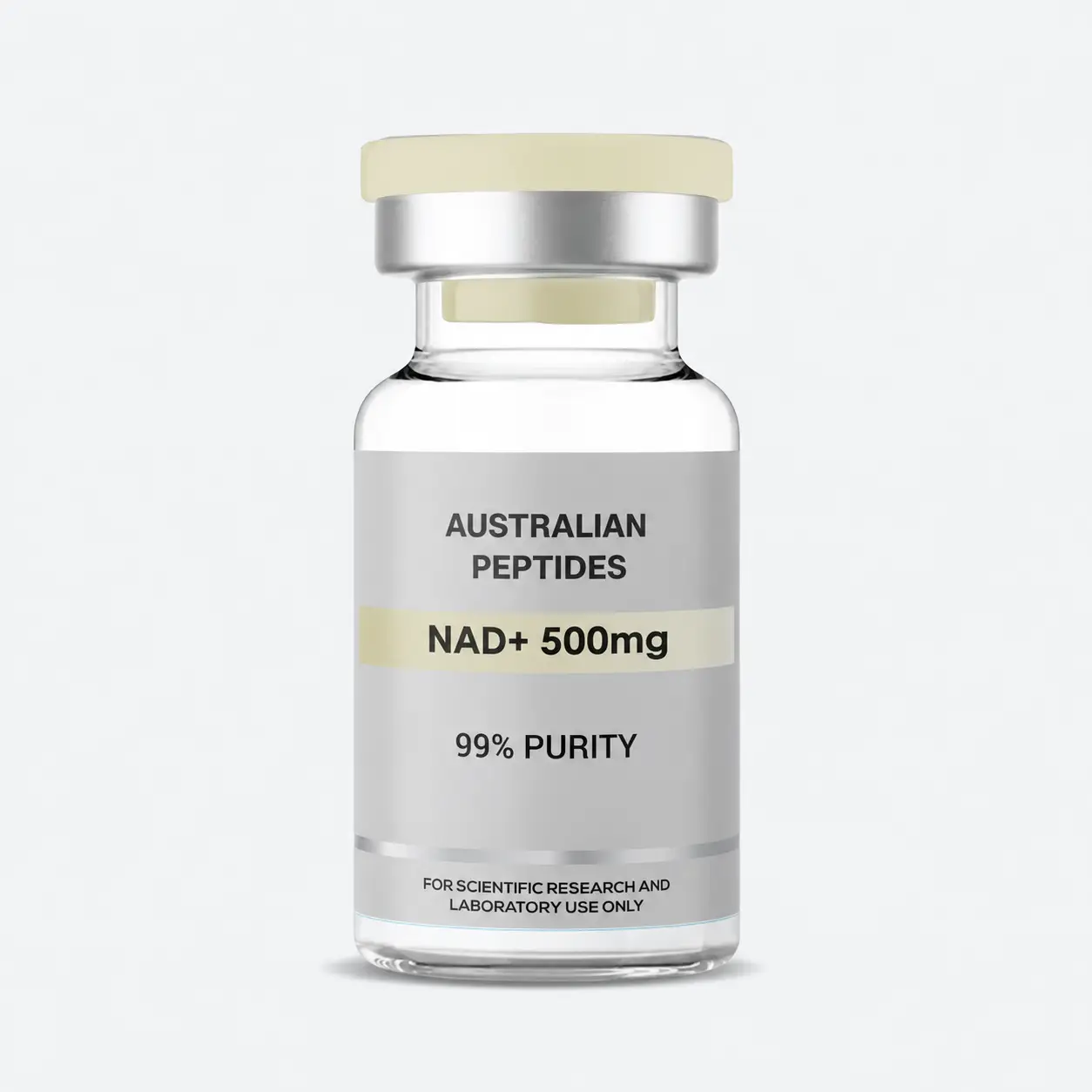
NAD+ (Nicotinamide Adenine Dinucleotide) 500mg & 1000mg is a nucleotide coenzyme investigated in cellular energy metabolism, redox reactions, mitochondrial physiology and NAD-dependent enzyme signalling.
Available from Peps Aussie Australia for controlled laboratory research and analytical applications.
For laboratory research use only. Not intended for human or animal consumption, injection, infusion, administration or therapeutic use.
Free Delivery on all orders above $320
NAD+ (Nicotinamide Adenine Dinucleotide) is an essential nucleotide coenzyme listed by Peps Aussie Australia as reference material for scientific investigation, laboratory analysis and controlled experimental research.
NAD+ plays an important role in cellular energy metabolism, oxidation–reduction reactions and enzyme-mediated signalling. It is found throughout living cells and participates in numerous biochemical pathways associated with metabolism and cellular regulation.
Published research has examined NAD+ in relation to mitochondrial physiology, glycolysis, the citric acid cycle, sirtuin activity, poly(ADP-ribose) polymerase (PARP) enzymes and NAD-associated metabolic pathways.
NAD+ is also widely investigated in cellular ageing research because intracellular NAD metabolism can change under different physiological and experimental conditions.
However, the biochemical importance of NAD+ does not establish that externally supplied NAD+ improves energy, reverses ageing, enhances recovery or provides clinically meaningful benefits through any particular administration method.
Unlike many compounds listed in research peptide catalogues, NAD+ is not a peptide. It is a nucleotide-derived coenzyme involved in cellular metabolism and biochemical signalling.
Peps Aussie lists NAD+ in nominal 500mg and 1000mg sizes for laboratory research and analytical applications.
Important: NAD+ is intended strictly for laboratory research and analytical purposes. It is not supplied for human or animal consumption, injection, infusion, administration, therapeutic use or clinical treatment.
NAD+ stands for Nicotinamide Adenine Dinucleotide.
It is a nucleotide coenzyme that participates in numerous metabolic and signalling processes.
NAD exists in different chemical forms, most notably:
These forms participate in oxidation–reduction reactions, commonly known as redox reactions, in which electrons are transferred between molecules.
During certain metabolic reactions, NAD+ accepts electrons and is converted to NADH.
NADH can subsequently participate in other biochemical processes, including pathways associated with mitochondrial energy production.
The NAD+/NADH system is fundamental to cellular metabolism.
It helps connect multiple biochemical pathways involved in the processing of carbohydrates, fats and other metabolic substrates.
Relevant biological processes include:
The relative abundance and compartmental distribution of NAD+ and NADH can influence cellular metabolic processes.
These relationships are central to biochemical research but do not establish the clinical effectiveness of an externally supplied NAD+ product.
Published research has examined NAD+ across numerous areas of biochemistry, molecular biology and experimental physiology.
The following sections describe established biochemical functions and scientific research topics rather than proven therapeutic outcomes from the Peps Aussie material.
One of the most important biological functions of NAD+ is its participation in cellular energy metabolism.
NAD+ acts as a coenzyme in enzyme-catalysed reactions involved in the breakdown and transformation of metabolic substrates.
Relevant research topics include:
These investigations contribute to understanding how cells generate and regulate energy.
The involvement of NAD+ in energy metabolism does not establish that external NAD+ administration increases energy levels or reduces fatigue in humans.
Mitochondria play a central role in cellular energy production.
NAD-associated redox reactions contribute to the transfer of electrons through metabolic pathways that support mitochondrial respiration.
Research involving NAD+ has examined:
These investigations are relevant to understanding mitochondrial physiology and cellular metabolic function.
Sirtuins are a family of enzymes that depend on NAD+ for certain catalytic activities.
They participate in molecular processes associated with protein modification, gene regulation and cellular responses to metabolic conditions.
Relevant research topics include:
Sirtuin research has contributed to broader scientific interest in NAD metabolism.
However, laboratory findings involving NAD-dependent enzymes do not establish anti-ageing benefits from commercially supplied NAD+.
Poly(ADP-ribose) polymerases, commonly known as PARPs, are enzymes involved in several cellular processes, including responses to DNA damage.
Certain PARP enzymes use NAD+ as a substrate during ADP-ribosylation reactions.
Research topics include:
These investigations contribute to understanding the relationship between NAD availability and enzyme-mediated cellular regulation.
They do not establish that externally supplied NAD+ repairs DNA or prevents disease.
NAD metabolism has become an important topic in experimental ageing biology.
Researchers have investigated how NAD availability, biosynthesis and consumption change across different cellular and animal models.
Relevant scientific topics include:
Some studies have explored NAD-related interventions in experimental systems.
However, these findings do not establish that a particular NAD+ formulation reverses ageing, extends human lifespan or prevents age-associated disease.
Cells maintain NAD through several biosynthetic and recycling pathways.
One important pathway is the NAD salvage pathway, which recycles nicotinamide and related metabolites into NAD.
Research in this area examines:
These pathways are relevant to understanding how cells maintain NAD availability under different physiological conditions.
NAD+ is often discussed alongside other molecules involved in NAD metabolism.
Although related, these compounds are chemically distinct.
NAD+:
NADH:
NMN (Nicotinamide Mononucleotide):
NR (Nicotinamide Riboside):
These compounds should not be treated as chemically identical or interchangeable.
NAD+ is also relevant to analytical investigations involving coenzyme identity, chemical stability and material quality.
Laboratories evaluating NAD+ may investigate:
Analytical techniques may include high-performance liquid chromatography (HPLC), mass spectrometry (MS) and other suitable biochemical methods.
Peps Aussie lists NAD+ in two nominal sizes: 500mg and 1000mg.
| Specification | Details |
|---|---|
| Product name | NAD+ |
| Full name | Nicotinamide Adenine Dinucleotide |
| Chemical classification | Nucleotide coenzyme |
| Peptide classification | Not a peptide |
| Listed sizes | 500mg and 1000mg |
| Biological form | Oxidised NAD |
| Related reduced form | NADH |
| Research category | Biochemistry and cellular metabolism |
| Research areas | Redox reactions, mitochondrial biology, sirtuins and PARP pathways |
| Supplier | Peps Aussie Australia |
| Intended use | Laboratory research and analytical investigation only |
The scientific characteristics above describe NAD+ as discussed in published literature. They do not independently verify the chemical identity, composition, purity or content of the supplied material.
Exact molecular identity, chemical form, salt or counterion composition, formulation, physical appearance, fill quantity and excipients should be confirmed against the applicable product label and supporting lot documentation.
Analytical verification is an important consideration when evaluating nucleotide coenzymes and laboratory research materials.
Peps Aussie maintains a dedicated resource where researchers can review available Certificates of Analysis and supporting analytical records.
View Peps Aussie Certificates of Analysis
When evaluating NAD+ analytical documentation, researchers should consider:
A certificate should be interpreted according to the tests actually performed.
The availability of a certificate does not automatically establish sterility, endotoxin status, a particular purity percentage, pharmaceutical-grade manufacturing or independent verification of every production batch.
Nucleotide coenzymes require appropriate handling to support sample integrity and experimental reproducibility.
Storage requirements for NAD+ depend on its chemical form, formulation, packaging and validated manufacturer stability information.
Laboratories should consider:
NAD+ stability may vary substantially depending on the formulation and preparation conditions.
No universal storage temperature or reconstitution procedure is recommended without verified product-specific documentation.
All laboratory work should be performed by appropriately qualified personnel using validated procedures and suitable safety controls.
Peps Aussie maintains an Australian-based catalogue of research peptides, biochemical compounds and laboratory materials for scientific and analytical applications.
NAD+ is listed in two nominal sizes:
Pricing and ordering availability should be confirmed through the product selection area. Inventory is currently pending confirmation.
For current information regarding Australian dispatch, delivery arrangements, processing times and applicable restrictions, visit the Peps Aussie Shipping Policy.
NAD+ is nicotinamide adenine dinucleotide, a nucleotide coenzyme involved in cellular redox reactions, energy metabolism and enzyme-mediated signalling.
No. NAD+ is a nucleotide coenzyme, not a peptide. It is included in biochemical research catalogues because of its importance in cellular metabolism.
Published research has examined NAD+ in relation to cellular energy metabolism, mitochondrial physiology, sirtuin enzymes, PARP activity, DNA damage responses and NAD biosynthesis pathways.
NAD+ is the oxidised form of nicotinamide adenine dinucleotide, while NADH is its reduced form. Both participate in cellular redox reactions.
No. NMN is nicotinamide mononucleotide, a molecule involved in NAD biosynthesis. NAD+ and NMN are chemically distinct.
Sirtuins are a family of NAD-dependent enzymes involved in protein modification, metabolic regulation and cellular signalling.
No established clinical evidence demonstrates that commercially supplied NAD+ reverses human ageing or extends lifespan. Research involving NAD metabolism and ageing remains an active scientific field.
NAD+ plays an essential biochemical role in cellular energy metabolism. However, this does not establish that a particular externally supplied NAD+ formulation increases energy or reduces fatigue in humans.
NAD metabolism and related compounds have been investigated in clinical and preclinical research. Findings depend on the exact compound, formulation, administration method and study design.
These findings do not establish clinical suitability for the Peps Aussie research material.
Peps Aussie lists NAD+ in 500mg and 1000mg nominal sizes. Researchers should verify the selected product variation, individual vial label and supporting analytical documentation.
Available analytical documentation can be reviewed through the Peps Aussie Certificates of Analysis page. Researchers should confirm that any applicable certificate corresponds to the specific production lot and evaluate the tests performed.
Storage requirements depend on the chemical form, formulation and validated stability characteristics. Follow the manufacturer’s product-specific documentation and established laboratory procedures.
No medical or veterinary approval is claimed for the Peps Aussie NAD+ research material.
This product is not supplied for human or animal consumption, injection, infusion, administration, diagnosis, prevention or treatment.
Peps Aussie maintains a catalogue of laboratory research materials for researchers investigating molecular biology, cellular metabolism and biochemical signalling.
NAD+ remains an important subject of scientific research because of its central role in redox chemistry, energy metabolism and enzyme-mediated cellular regulation.
Researchers evaluating NAD+ 500mg or 1000mg should prioritise accurate chemical identification, appropriate analytical documentation, batch traceability and validated laboratory procedures.
Explore the Peps Aussie research catalogue at pepsaussie.com.
NAD+ 500mg and 1000mg are intended strictly for laboratory research and analytical purposes only.
These products are not intended for human or animal consumption, injection, infusion, administration, therapeutic use or clinical treatment.
Descriptions of published scientific research are provided for educational and informational purposes only. They do not establish anti-ageing effects, increased energy, improved recovery, clinical safety or therapeutic suitability for the material offered.
No dosing, self-administration or therapeutic guidance is provided.
| Size | 500mg, 1000mg |
|---|
Reviews here are by invitation. We email a link once your order has arrived, so every review comes from someone who received the product. Lost the email? Find your review link.

Subscribe and we email you a single-use discount code. After that: new batch certificates as they are published, and restock alerts.

Reviews
There are no reviews yet.