
$70.00
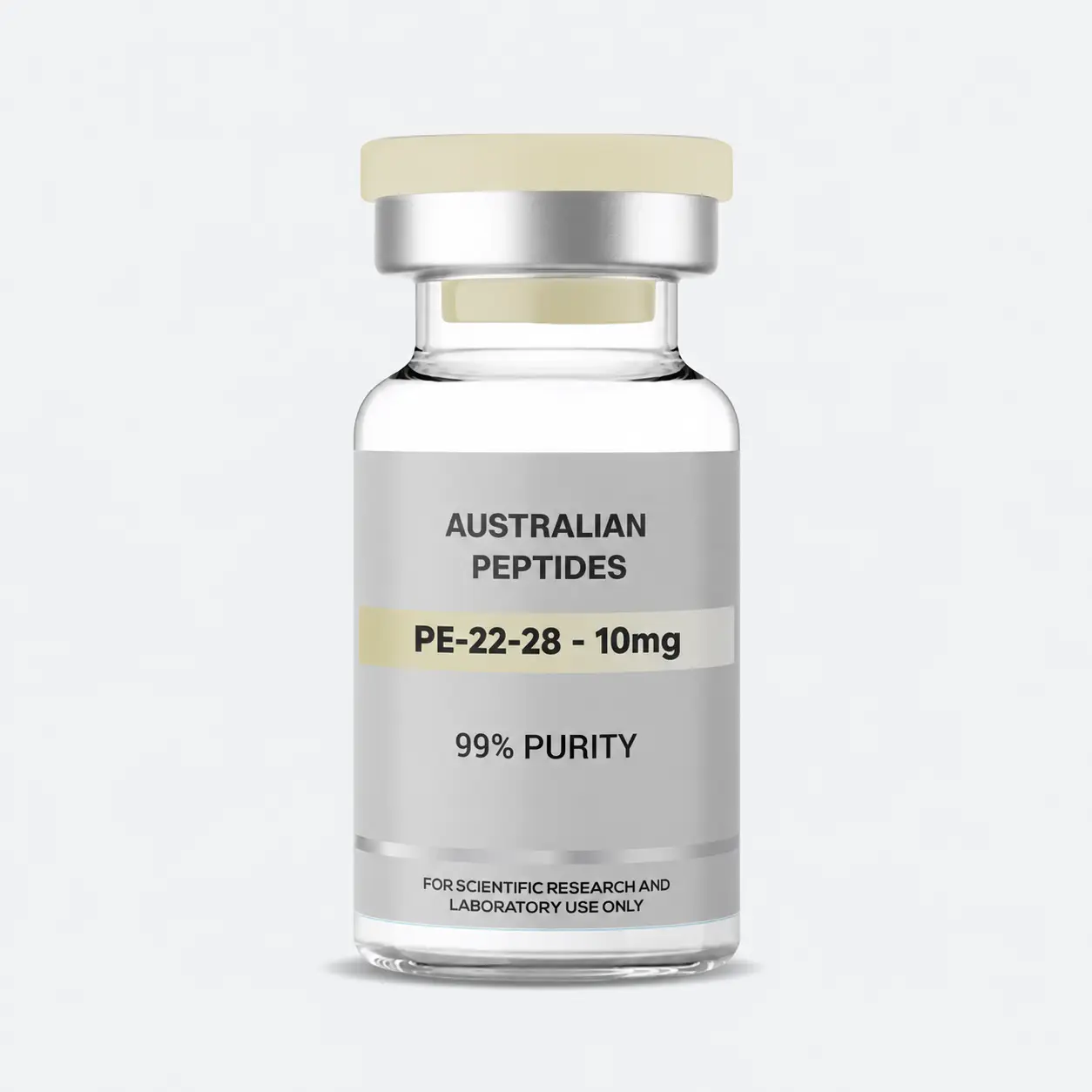
PE-22-28 10mg is an experimental peptide fragment associated with spadin-related neurobiology, TREK-1 potassium-channel signalling and experimental peptide pharmacology.
Available from Peps Aussie Australia for controlled laboratory research and analytical applications.
For laboratory research use only. Not intended for human or animal consumption, administration or therapeutic use. Findings involving spadin do not automatically establish activity for PE-22-28.
Free Delivery on all orders above $320
Out of stock
PE-22-28 10mg is an experimental peptide reference material listed by Peps Aussie Australia for scientific investigation, laboratory analysis and controlled experimental research.
PE-22-28 is associated with spadin-related neurobiology research, particularly scientific investigations involving the two-pore-domain potassium channel TREK-1.
Spadin is a peptide derived from the sortilin-associated peptide system and has been investigated in preclinical neuroscience research for its interactions with TREK-1 potassium-channel signalling.
Experimental research involving spadin and related peptide sequences has explored neuronal excitability, potassium-channel pharmacology, neurobiological signalling and behavioural models.
However, PE-22-28 should not automatically be considered chemically or pharmacologically equivalent to spadin.
The biological characteristics of any PE-22-28 preparation depend on its exact amino acid sequence, molecular modifications, formulation and analytical identity.
Published findings involving spadin or related fragments do not establish that independently supplied PE-22-28 material produces the same experimental outcomes.
Peps Aussie lists PE-22-28 in a nominal 10mg size for laboratory research and analytical applications.
Important: PE-22-28 is intended strictly for laboratory research and analytical purposes. It is not supplied for human or animal consumption, injection, nasal administration, therapeutic use or clinical treatment.
PE-22-28 is a designation used for an experimental peptide fragment associated with spadin-related research.
Spadin is a naturally derived peptide fragment associated with sortilin, a protein involved in cellular trafficking and signalling processes.
Research involving spadin has examined interactions with TREK-1, a potassium channel belonging to the two-pore-domain potassium channel family.
TREK-1 is also known as KCNK2, reflecting the gene encoding the channel.
The channel participates in the regulation of potassium movement across cell membranes and contributes to electrical properties of certain cells, including neurons.
Research involving PE-22-28 and related peptide fragments is therefore relevant to:
These areas contribute to understanding experimental peptide–channel interactions.
Spadin has been investigated as a peptide capable of modulating TREK-1-associated activity in experimental systems.
TREK-1 belongs to the K2P potassium-channel family, which contributes to background potassium conductance and the regulation of membrane electrical properties.
Research involving TREK-1 has examined:
PE-22-28 is associated with this research field, but its specific channel activity must be established through direct experimental evidence.
Scientific interest in PE-22-28 relates to several overlapping areas of neuroscience, peptide chemistry and ion-channel pharmacology.
The following sections describe research topics and mechanistic hypotheses rather than proven effects of the Peps Aussie material.
One of the primary areas associated with PE-22-28 research is TREK-1 potassium-channel biology.
TREK-1 is a member of the two-pore-domain potassium-channel family and participates in the regulation of cellular membrane electrical properties.
Relevant research topics include:
These investigations contribute to understanding the molecular regulation of potassium channels.
However, TREK-1 activity demonstrated for spadin or another peptide does not automatically establish identical activity for PE-22-28.
Neuronal excitability depends on the coordinated activity of ion channels and other membrane-associated proteins.
Potassium channels contribute to the regulation of electrical signalling in neurons.
Research involving TREK-1 and related pathways has examined:
These investigations are relevant to the broader study of nervous system physiology.
Spadin has attracted scientific interest because of its reported interactions with TREK-1 in certain preclinical experimental systems.
Researchers have examined spadin and related peptide fragments to understand how structural differences influence biological activity.
Relevant research topics include:
Findings involving spadin should not be directly attributed to PE-22-28 without confirming that the relevant molecular characteristics and biological activities are comparable.
Preclinical studies involving spadin and related experimental compounds have examined behavioural models associated with neurological signalling.
These investigations have contributed to interest in TREK-1 as a potential research target.
Relevant topics include:
Behavioural observations from animal models do not establish that PE-22-28 treats depression, anxiety or other neurological conditions.
Ion channels are important molecular targets in experimental pharmacology.
TREK-1 research has examined how different biological and chemical factors influence potassium-channel activity.
Relevant research areas include:
These studies contribute to understanding how peptide-related compounds may interact with ion-channel systems.
Small changes in peptide sequence or molecular structure can influence biological activity.
Research involving spadin-related peptide fragments has examined the relationship between peptide structure and experimental pharmacological behaviour.
Relevant scientific topics include:
These considerations are particularly important when evaluating a material described as PE-22-28.
A product name alone does not establish the exact molecular structure or activity of the supplied material.
PE-22-28 and spadin are related research terms but should not automatically be treated as interchangeable.
Spadin:
PE-22-28:
Researchers should distinguish between published findings involving spadin and findings directly established for a particular PE-22-28 preparation.
PE-22-28 is also relevant to analytical investigations involving synthetic peptide identity, molecular structure and material quality.
Laboratories evaluating PE-22-28 may investigate:
Analytical techniques such as high-performance liquid chromatography (HPLC) and mass spectrometry (MS) may be appropriate depending on the formulation and testing objectives.
Peps Aussie lists PE-22-28 in a nominal 10mg size.
| Specification | Details |
|---|---|
| Product name | PE-22-28 |
| Listed size | 10mg |
| Material type | Experimental peptide fragment |
| Research association | Spadin-related neurobiology |
| Related molecular target | TREK-1 potassium channel |
| Related gene | KCNK2 |
| Research category | Neuropeptide and ion-channel research |
| Research areas | TREK-1 signalling, neuronal excitability and peptide pharmacology |
| Exact peptide sequence | Requires confirmation against product documentation |
| Supplier | Peps Aussie Australia |
| Intended use | Laboratory research and analytical investigation only |
The scientific characteristics above describe the research context associated with PE-22-28. They do not independently verify the identity, composition, purity or content of the supplied material.
Exact molecular identity, amino acid sequence, terminal modifications, salt form, formulation, physical appearance, fill quantity and excipients should be confirmed against the applicable product label and supporting lot documentation.
Analytical verification is particularly important when evaluating experimental peptide fragments.
Peps Aussie maintains a dedicated resource where researchers can review available Certificates of Analysis and supporting analytical records.
View Peps Aussie Certificates of Analysis
When evaluating PE-22-28 analytical documentation, researchers should consider:
High-performance liquid chromatography and mass spectrometry are commonly used in peptide characterisation.
A certificate should be interpreted according to the tests actually performed.
The availability of a certificate does not automatically establish sterility, endotoxin status, a particular purity percentage, pharmaceutical-grade manufacturing or independent verification of every production batch.
Research peptides require appropriate handling to support sample integrity and experimental reproducibility.
Storage requirements for PE-22-28 depend on the molecular structure, formulation, packaging and validated manufacturer stability information.
Laboratories should consider:
No universal storage temperature or reconstitution procedure is recommended without verified product-specific documentation.
All laboratory work should be performed by appropriately qualified personnel using validated procedures and suitable safety controls.
Peps Aussie maintains an Australian-based catalogue of research peptides and laboratory materials for scientific and analytical applications.
PE-22-28 10mg is the currently listed nominal product size.
Pricing and ordering availability should be confirmed through the product selection area. Inventory is currently pending confirmation.
For current information regarding Australian dispatch, delivery arrangements, processing times and applicable restrictions, visit the Peps Aussie Shipping Policy.
PE-22-28 is an experimental peptide fragment associated with spadin-related neurobiology research and investigations involving TREK-1 potassium-channel signalling.
Scientific interest includes TREK-1 potassium-channel pharmacology, neuronal excitability, peptide structure–activity relationships and experimental behavioural models.
Not necessarily. PE-22-28 is associated with spadin-related peptide research, but its exact molecular identity and biological characteristics must be verified separately.
TREK-1 is a two-pore-domain potassium channel involved in the regulation of cellular membrane electrical properties, including neuronal excitability.
KCNK2 is the gene that encodes the TREK-1 potassium channel.
Spadin and related peptides have been investigated for TREK-1 modulation in preclinical systems. However, activity demonstrated for spadin cannot automatically be attributed to every PE-22-28 preparation.
PE-22-28 is an experimental research peptide, not an established antidepressant medicine. Findings from behavioural models involving related peptides do not demonstrate clinical efficacy for depression.
PE-22-28 is sometimes discussed in experimental neurobiology contexts. However, there is no established basis for claiming cognitive enhancement or other clinical benefits from the Peps Aussie material.
The exact sequence should be confirmed against the applicable supplier documentation and analytical records. The product name alone should not be treated as sufficient evidence of molecular identity.
Peps Aussie lists PE-22-28 in a 10mg nominal size. Researchers should verify the individual vial label and supporting analytical documentation.
Available analytical documentation can be reviewed through the Peps Aussie Certificates of Analysis page. Researchers should confirm that any applicable certificate corresponds to the specific production lot and evaluate the tests performed.
Storage requirements depend on the molecular structure, formulation and validated stability characteristics. Follow the manufacturer’s product-specific documentation and established laboratory procedures.
No medical or veterinary approval is claimed for the Peps Aussie PE-22-28 research product.
This product is not supplied for human or animal consumption, administration, diagnosis, prevention or treatment.
Peps Aussie maintains a catalogue of laboratory research peptides and scientific materials for researchers investigating neuroscience, molecular biology and cellular signalling.
PE-22-28 remains a subject of research interest because of its association with spadin-related peptide chemistry and TREK-1 potassium-channel biology.
Researchers evaluating PE-22-28 10mg should prioritise accurate molecular identification, appropriate analytical documentation, batch traceability and validated laboratory procedures.
Explore the Peps Aussie research catalogue at pepsaussie.com.
PE-22-28 10mg is intended strictly for laboratory research and analytical purposes only.
This product is not intended for human or animal consumption, injection, nasal administration, therapeutic use or clinical treatment.
Descriptions of published scientific research are provided for educational and informational purposes only. They do not establish antidepressant effects, cognitive enhancement, neurological benefits, clinical safety or therapeutic suitability for the material offered.
Findings involving spadin or other peptide fragments must not be assumed to apply to the supplied PE-22-28 material without direct supporting evidence.
No dosing, self-administration or therapeutic guidance is provided.
| Size | 10mg |
|---|
Reviews here are by invitation. We email a link once your order has arrived, so every review comes from someone who received the product. Lost the email? Find your review link.

Subscribe and we email you a single-use discount code. After that: new batch certificates as they are published, and restock alerts.

Reviews
There are no reviews yet.