
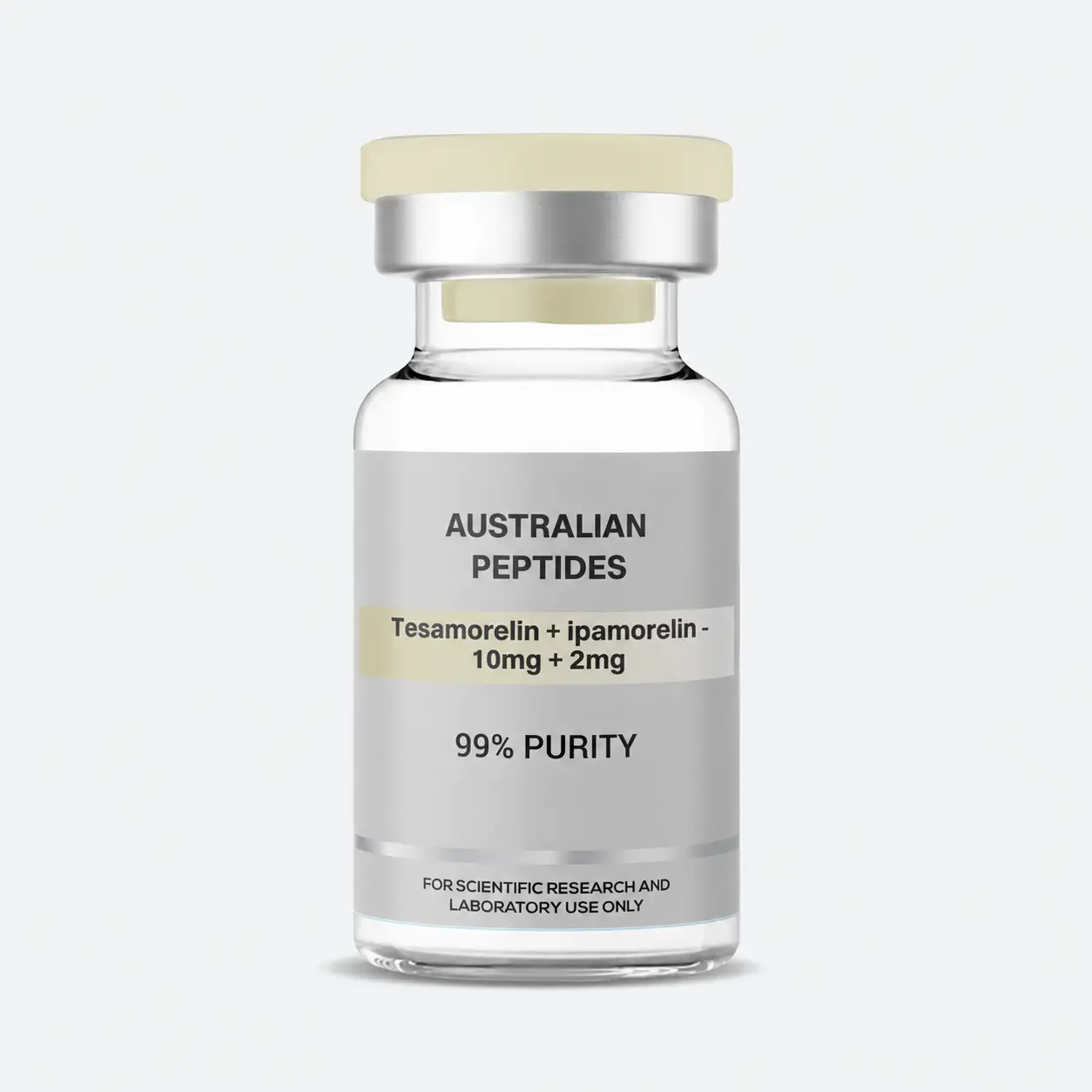
$130.00
Tesamorelin + Ipamorelin 10mg + 2mg is a dual-peptide research blend combining two distinct compounds investigated in growth hormone regulation, GHRH receptor signalling, GHSR1a activation and neuroendocrine physiology.
Available from Peps Aussie Australia for controlled laboratory research and analytical applications.
For laboratory research use only. Not intended for human or animal consumption, administration or therapeutic use.
Free Delivery on all orders above $320
Out of stock
Tesamorelin + Ipamorelin 10mg + 2mg is a dual-peptide research blend listed by Peps Aussie Australia for scientific investigation, laboratory analysis and controlled experimental research.
This formulation combines two distinct peptides studied in endocrine signalling research: Tesamorelin, a growth hormone-releasing hormone (GHRH) receptor agonist, and Ipamorelin, a growth hormone secretagogue receptor (GHSR) agonist.
Both peptides have been independently investigated for their interactions with receptors involved in growth hormone regulation, pituitary signalling and neuroendocrine physiology. Their different receptor targets make them relevant to scientific questions involving parallel signalling pathways and potential interactions between endocrine regulatory systems.
Peps Aussie lists this research blend with separate nominal component quantities of 10mg Tesamorelin + 2mg Ipamorelin, representing 12mg of combined nominal peptide content.
Important: This product is intended strictly for laboratory research and analytical purposes. It is not supplied for human or animal consumption, injection, administration, therapeutic use or clinical treatment.
Tesamorelin + Ipamorelin is a research formulation containing two synthetic peptides associated with distinct receptor signalling mechanisms.
Although both compounds have been studied in growth hormone-related research, they differ in molecular structure, receptor selectivity and signalling pathways.
Tesamorelin is a synthetic analogue of human growth hormone-releasing hormone (GHRH).
It is designed to interact with the GHRH receptor, a G protein-coupled receptor involved in the regulation of growth hormone secretion from the anterior pituitary gland.
Published research has examined Tesamorelin in relation to:
Tesamorelin has also been investigated in clinical research involving specific metabolic conditions. However, findings from clinical studies of regulated pharmaceutical formulations cannot be assumed to apply to an unlicensed research material or combination product.
Ipamorelin is a synthetic pentapeptide investigated for its activity at the growth hormone secretagogue receptor, commonly referred to as GHSR1a.
This receptor is also associated with the endogenous hormone ghrelin and participates in several neuroendocrine signalling processes.
Research involving Ipamorelin has examined:
Ipamorelin is structurally and pharmacologically distinct from Tesamorelin, making the two peptides relevant to comparative receptor signalling investigations.
Scientific literature has examined Tesamorelin and Ipamorelin individually across several areas of endocrine and molecular biology.
Research involving the exact combined formulation is substantially more limited. Findings from individual peptide studies should not be interpreted as evidence of additive, synergistic or clinically beneficial effects from the blend.
Tesamorelin is investigated for its interaction with the GHRH receptor, which contributes to the regulation of growth hormone secretion.
Laboratory studies involving GHRH receptor agonists have examined:
These investigations contribute to understanding the molecular mechanisms involved in endocrine communication.
Ipamorelin is investigated as an agonist of the ghrelin-associated growth hormone secretagogue receptor.
GHSR1a signalling has been studied in relation to intracellular calcium regulation, G protein activation and endocrine response mechanisms.
Relevant research topics include:
The precise responses observed depend on receptor expression, experimental conditions and the biological model used.
A central scientific question associated with Tesamorelin + Ipamorelin concerns the interaction between two distinct endocrine signalling pathways.
Tesamorelin primarily targets GHRH receptors, while Ipamorelin targets GHSR1a receptors.
Because these receptors participate in overlapping endocrine regulatory systems, researchers may investigate how their signalling pathways interact under controlled experimental conditions.
Potential laboratory research questions include:
Importantly, the presence of two receptor agonists in one formulation does not establish that their combined effects are additive or synergistic.
Any such relationship would require direct experimental evidence involving the specific combination.
Growth hormone regulation involves complex interactions between the hypothalamus, pituitary gland and peripheral endocrine systems.
Tesamorelin and Ipamorelin have been studied independently in relation to these regulatory pathways.
Relevant areas of scientific investigation include:
These research topics are relevant to understanding normal endocrine physiology and receptor-mediated communication.
Growth hormone signalling is associated with downstream pathways involving insulin-like growth factor 1 (IGF-1).
Scientific investigations of growth hormone regulatory mechanisms have examined the relationship between pituitary signalling, circulating hormones and downstream cellular responses.
Research considerations include:
Observations from studies of individual compounds should not be generalised to the Tesamorelin + Ipamorelin blend without direct supporting evidence.
Research peptide blends introduce additional analytical considerations compared with single-compound materials.
Laboratories evaluating a dual-peptide formulation may need to distinguish and quantify each component independently.
Relevant analytical topics include:
These considerations are important for evaluating the identity and composition of research materials containing multiple peptides.
Peps Aussie lists this dual-peptide formulation with separate nominal quantities of 10mg Tesamorelin and 2mg Ipamorelin.
| Specification | Details |
|---|---|
| Product name | Tesamorelin + Ipamorelin |
| Product type | Dual-peptide research blend |
| Component 1 | Tesamorelin |
| Component 2 | Ipamorelin |
| Tesamorelin nominal content | 10mg |
| Ipamorelin nominal content | 2mg |
| Total nominal peptide content | 12mg |
| Tesamorelin research target | GHRH receptor |
| Ipamorelin research target | GHSR1a |
| Research category | Endocrinology and receptor signalling |
| Supplier | Peps Aussie Australia |
| Intended use | Laboratory research and analytical investigation only |
The listed 10mg + 2mg amounts refer to separate nominal peptide quantities, not a single 10mg or 2mg total.
The information above describes the intended component identities and their established scientific classifications. It does not independently verify the identity, composition, purity or content of the supplied formulation.
Researchers should confirm both peptide identities and quantities against the applicable product label and lot documentation.
Analytical verification is particularly important for research formulations containing multiple peptide components.
Peps Aussie provides a dedicated resource where researchers can review available Certificates of Analysis and supporting analytical documentation.
View Peps Aussie Certificates of Analysis
When evaluating a Tesamorelin + Ipamorelin blend, researchers should consider:
High-performance liquid chromatography (HPLC) and mass spectrometry (MS) may be used for peptide characterisation, depending on the analytical requirements.
For a dual-peptide formulation, a single overall purity figure may not establish the individual purity or content of each component.
The availability of a certificate does not automatically establish sterility, endotoxin status, a specific purity percentage or independent testing of every production batch.
Research peptide blends require appropriate handling to maintain sample integrity and support reproducible analytical results.
Storage requirements depend on the characteristics of both peptides, their formulation and validated manufacturer stability information.
Laboratories should consider:
Because Tesamorelin and Ipamorelin are distinct molecules, researchers should not assume that conditions suitable for one peptide are automatically suitable for the combined formulation.
No universal storage temperature or reconstitution method is recommended without verified product-specific documentation.
All laboratory work should be performed by appropriately qualified personnel using validated procedures and suitable safety controls.
Peps Aussie maintains an Australian-based catalogue of research peptides and laboratory materials for scientific and analytical applications.
Tesamorelin + Ipamorelin 10mg + 2mg is the currently listed formulation.
Pricing and ordering availability should be confirmed through the product selection area. Inventory is currently pending confirmation.
For current information regarding Australian dispatch, delivery arrangements, processing times and applicable restrictions, visit the Peps Aussie Shipping Policy.
Tesamorelin + Ipamorelin is a dual-peptide formulation combining a GHRH receptor agonist and a growth hormone secretagogue receptor agonist. Both peptides have been studied independently in endocrine and receptor signalling research.
Tesamorelin has been investigated in research involving GHRH receptor activation, pituitary signalling, growth hormone regulation and downstream endocrine pathways.
Ipamorelin has been investigated for its activity at GHSR1a receptors and its relationship with growth hormone secretagogue signalling and neuroendocrine regulation.
Tesamorelin acts primarily through GHRH receptors, while Ipamorelin acts through ghrelin-associated GHSR1a receptors. Their distinct receptor targets make them relevant to comparative endocrine signalling research.
The product is listed with nominal quantities of 10mg Tesamorelin and 2mg Ipamorelin, representing 12mg of combined nominal peptide content. These quantities should be verified against the product label and applicable analytical documentation.
Evidence specifically evaluating this exact combined formulation is limited. Research involving the individual peptides does not establish additive, synergistic or clinically beneficial effects when they are combined.
Available analytical documentation can be reviewed through the Peps Aussie Certificates of Analysis page. Researchers should verify that any applicable certificate corresponds to the specific lot and identifies which components and characteristics were tested.
Storage requirements depend on the formulation and validated stability characteristics of both peptides. Follow the manufacturer’s product-specific documentation and established laboratory procedures.
Tesamorelin has been authorised in certain jurisdictions as part of specific regulated pharmaceutical products. That approval does not extend to this research blend.
No medical or veterinary approval is claimed for the Peps Aussie Tesamorelin + Ipamorelin formulation.
No. Peps Aussie lists this formulation strictly as a laboratory research material. It is not supplied for human or animal consumption, injection, administration, diagnosis, prevention or treatment.
Peps Aussie maintains a catalogue of laboratory research peptides and scientific materials for researchers investigating molecular biology, endocrinology and receptor signalling.
Tesamorelin and Ipamorelin are scientifically distinct peptides associated with separate endocrine receptor pathways.
Researchers evaluating this combined formulation should prioritise accurate identification of both components, suitable analytical documentation, batch traceability and validated laboratory procedures.
Explore the Peps Aussie research catalogue at pepsaussie.com.
Tesamorelin + Ipamorelin 10mg + 2mg is intended strictly for laboratory research and analytical purposes only.
This product is not intended for human or animal consumption, injection, administration, therapeutic use or clinical treatment.
Descriptions of published scientific research are provided for educational and informational purposes only. They do not establish the quality, biological activity, clinical efficacy or safety of the product offered.
No dosing, self-administration or therapeutic guidance is provided.
| Size | 10mg + 2mg |
|---|
Reviews here are by invitation. We email a link once your order has arrived, so every review comes from someone who received the product. Lost the email? Find your review link.

Subscribe and we email you a single-use discount code. After that: new batch certificates as they are published, and restock alerts.

Reviews
There are no reviews yet.