
$70.00
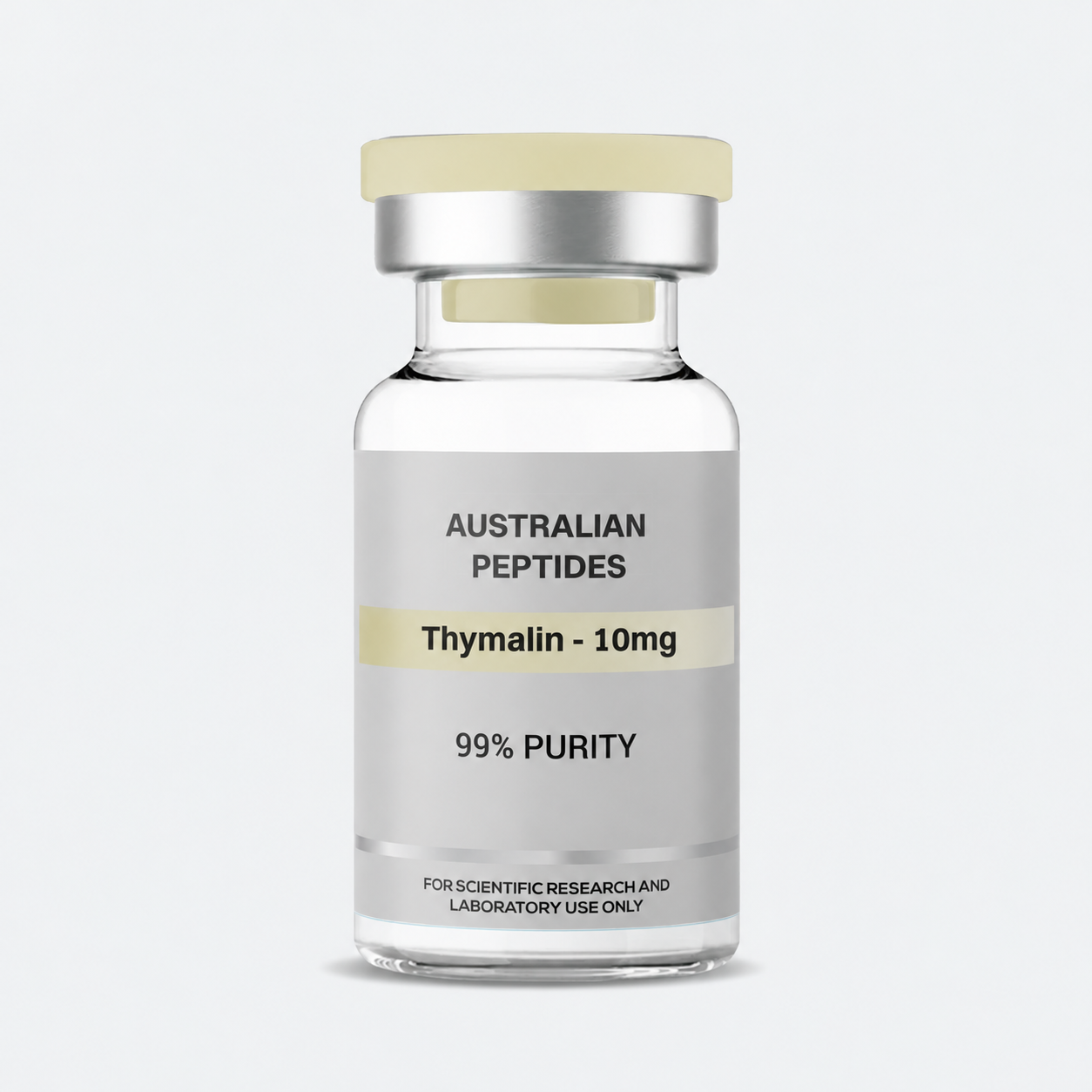
Thymalin 10mg is a thymic peptide research material historically investigated in scientific studies involving T-cell function, immune system signalling, thymic biology and age-associated immune changes.
Available from Peps Aussie Australia for controlled laboratory research and analytical applications.
For laboratory research use only. Not intended for human or animal consumption, administration or therapeutic use.
Free Delivery on all orders above $320
Out of stock
Thymalin 10mg is a laboratory research material listed by Peps Aussie Australia for scientific investigation, analytical testing and controlled experimental research.
Thymalin is a name historically associated with thymus-derived peptide preparations studied in immunology, cellular signalling and experimental gerontology. Research involving thymic peptide preparations has examined their relationship with immune cell activity, T-lymphocyte function, inflammatory signalling and age-associated changes in immune regulation.
Unlike peptides defined by a single established amino acid sequence, Thymalin has historically referred to preparations containing multiple thymus-derived peptide components. Consequently, the composition and analytical characteristics of a particular Thymalin product are important considerations when interpreting published research.
Peps Aussie lists Thymalin 10mg as reference material for laboratory research. Researchers should review the applicable product documentation, composition information and analytical records before incorporating the material into experimental investigations.
Important: Thymalin 10mg is intended strictly for laboratory research and analytical purposes. It is not supplied for human or animal consumption, injection, administration, therapeutic use or clinical treatment.
Thymalin is a name associated with thymus-derived peptide preparations historically investigated for their relationship with immune system function and cellular regulation.
The thymus is a primary lymphoid organ involved in the development and maturation of T lymphocytes, which contribute to adaptive immune responses.
Thymus-derived peptide preparations have attracted scientific interest because of their potential interactions with immune cells and signalling pathways associated with immune regulation.
Historical Thymalin research has examined preparations obtained from thymic tissue, often involving mixtures of low-molecular-weight peptide components.
This distinction is important because Thymalin should not automatically be treated as a single chemically defined peptide with one universally accepted molecular formula, molecular weight or amino acid sequence.
Several compounds and preparations associated with thymic research have similar names but different chemical characteristics.
These substances are not interchangeable. Findings involving one thymic peptide should not automatically be applied to another.
Published research has investigated Thymalin and related thymic peptide preparations across several areas of experimental immunology and cellular biology.
The following sections describe scientific research topics and do not establish therapeutic effectiveness, clinical suitability or biological activity for the specific material offered by Peps Aussie.
One of the principal areas of historical Thymalin research involves the relationship between thymus-derived peptide preparations and T lymphocyte function.
T cells are important components of adaptive immunity and participate in immune recognition, cellular communication and the coordination of immune responses.
Experimental investigations have examined:
These investigations contribute to the scientific understanding of thymic biology and immune regulation.
Because historical Thymalin preparations may differ in composition, reported findings cannot necessarily be generalised across products carrying the same name.
Thymalin-related research has explored how thymus-derived peptide preparations may influence cellular communication within the immune system.
Laboratory studies have investigated changes in immune-associated markers and signalling responses under different experimental conditions.
Relevant research topics include:
The magnitude and direction of reported effects may vary according to preparation composition, biological model and study methodology.
The thymus plays a central role in the maturation and selection of T lymphocytes.
Research involving thymic peptide preparations has contributed to broader investigations into the relationship between thymic tissue, immune cell development and physiological regulation.
Areas of scientific interest include:
These investigations help researchers understand the biological importance of thymic tissue and its associated signalling systems.
The thymus undergoes structural and functional changes with age, a process commonly described as thymic involution.
Historical research involving Thymalin and other thymus-derived preparations has examined immune-related changes in ageing experimental models.
Relevant research questions include:
These investigations are part of experimental gerontology and immunology.
They do not establish that Thymalin reverses ageing, extends lifespan or provides clinically meaningful anti-ageing benefits.
Some research involving thymic peptide preparations has investigated their relationship with inflammatory responses and immune-associated signalling pathways.
Experimental areas include:
Results should be interpreted in the context of the specific preparation, experimental design and analytical methods used.
Because Thymalin may refer to a mixture rather than a single molecular species, analytical characterisation is particularly important.
Researchers evaluating a Thymalin preparation may investigate:
Analytical techniques such as liquid chromatography and mass spectrometry may help characterise complex peptide preparations.
However, the suitability of each method depends on the formulation, sample characteristics and analytical objectives.
Peps Aussie lists Thymalin in a nominal 10mg size.
| Specification | Details |
|---|---|
| Product name | Thymalin |
| Listed size | 10mg |
| Product category | Thymic peptide research material |
| Historical origin | Thymus-derived peptide preparations |
| Chemical identity | Preparation-dependent; verify documentation |
| Amino acid sequence | No single universal sequence established |
| Molecular weight | Dependent on component composition |
| Research areas | Immunology, thymic biology and cellular signalling |
| Supplier | Peps Aussie Australia |
| Intended use | Laboratory research and analytical investigation only |
The nominal 10mg size refers to the labelled product quantity and does not independently establish the mass or concentration of individual peptide components.
Exact molecular identity, composition, formulation, physical appearance, fill quantity and excipients should be confirmed against the applicable product label and supporting documentation.
Analytical verification is an important consideration when evaluating research materials, particularly those associated with complex peptide mixtures.
Peps Aussie maintains a dedicated resource where researchers can review available Certificates of Analysis and supporting analytical records.
View Peps Aussie Certificates of Analysis
When evaluating Thymalin analytical documentation, researchers should consider:
For multi-component preparations, a single reported purity percentage may not adequately describe the identity or relative abundance of individual constituents.
A certificate should be evaluated according to the tests actually performed and the specific batch examined.
The availability of analytical documentation does not automatically establish sterility, endotoxin status, a particular purity percentage or independent verification of every production batch.
Research peptide preparations require appropriate handling to support material integrity and experimental reproducibility.
Storage conditions for Thymalin depend on its composition, formulation, packaging and validated manufacturer stability information.
Laboratories should evaluate:
Because Thymalin preparations may contain multiple peptide components, researchers should not assume that stability characteristics are identical to those of a single chemically defined peptide.
No universal storage temperature or reconstitution procedure is recommended without verified product-specific documentation.
All handling should be performed by appropriately qualified personnel using validated laboratory procedures and suitable safety controls.
Peps Aussie maintains an Australian-based catalogue of laboratory research peptides and scientific reference materials.
Thymalin 10mg is the currently listed nominal product size.
Pricing and ordering availability should be confirmed through the product selection area. Inventory is currently pending confirmation.
For information about Australian dispatch, shipping methods, processing times and applicable restrictions, visit the Peps Aussie Shipping Policy.
Thymalin is a name historically associated with thymus-derived peptide preparations investigated in immunology and cellular biology. Unlike a single chemically defined peptide, its composition may vary between preparations.
Historical research has examined Thymalin and related thymic peptide preparations in relation to T-cell responses, immune regulation, thymic biology, inflammatory signalling and age-associated immune changes.
Not necessarily. Thymalin has historically been associated with multi-component peptide preparations rather than one universally defined amino acid sequence. The exact identity of a commercial product should be verified using appropriate analytical documentation.
No. Thymosin Alpha-1 is a chemically defined 28-amino-acid peptide, whereas Thymalin is historically associated with thymus-derived peptide preparations that may contain multiple components.
No. Thymopentin is a defined synthetic pentapeptide. It should not be assumed to have the same composition or biological properties as Thymalin.
Historical investigations have examined thymic peptide preparations in relation to age-associated immune changes and experimental gerontology. These studies do not establish that Thymalin reverses ageing or extends lifespan.
Peps Aussie lists Thymalin in a 10mg nominal size. Researchers should verify the product label and any applicable analytical documentation.
Available analytical documentation can be reviewed through the Peps Aussie Certificates of Analysis page. Researchers should confirm that any certificate corresponds to the specific production lot and adequately describes the tests performed.
Storage requirements depend on the material’s composition, formulation and validated stability characteristics. Follow the manufacturer’s product-specific instructions and established laboratory procedures.
No medical or veterinary approval is claimed for this research product. Historical clinical use or research involving other Thymalin preparations does not establish regulatory approval or clinical suitability for the material listed by Peps Aussie.
No. Peps Aussie lists Thymalin strictly as a laboratory research material. It is not supplied for human or animal consumption, injection, administration, diagnosis, prevention or treatment.
Peps Aussie maintains a catalogue of laboratory research peptides and scientific materials for researchers investigating molecular biology, immunology and cellular signalling.
Thymalin remains a subject of historical and analytical interest because of its association with thymus-derived peptide preparations and immune-related research.
Researchers evaluating Thymalin 10mg should prioritise accurate material identification, suitable analytical documentation, batch traceability and appropriate laboratory handling.
Explore the Peps Aussie research catalogue at pepsaussie.com.
Thymalin 10mg is intended strictly for laboratory research and analytical purposes only.
This product is not intended for human or animal consumption, injection, administration, therapeutic use or clinical treatment.
Descriptions of published scientific research are provided for educational and informational purposes only. They do not establish the quality, biological activity, clinical efficacy or safety of the product offered.
No dosing, self-administration or therapeutic guidance is provided.
| Size | 10mg |
|---|
Reviews here are by invitation. We email a link once your order has arrived, so every review comes from someone who received the product. Lost the email? Find your review link.

Subscribe and we email you a single-use discount code. After that: new batch certificates as they are published, and restock alerts.

Reviews
There are no reviews yet.