
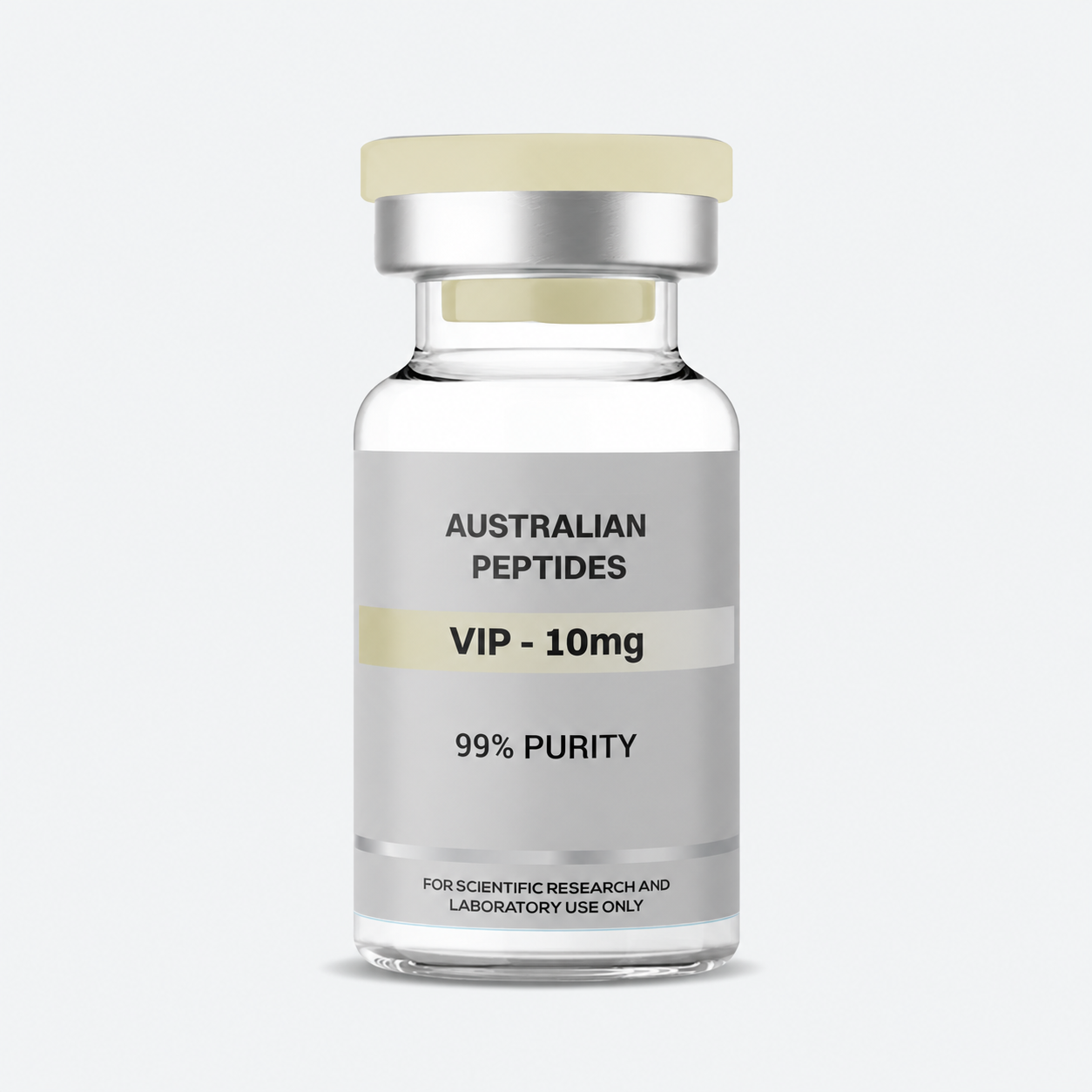
$120.00
VIP 10mg (Vasoactive Intestinal Peptide) is a naturally occurring 28-amino-acid neuropeptide widely investigated in scientific research involving VPAC receptor signalling, immune regulation, smooth muscle physiology and neuroendocrine pathways.
Available from Peps Aussie Australia for controlled laboratory research and analytical applications.
For laboratory research use only. Not intended for human or animal consumption, administration or therapeutic use.
Free Delivery on all orders above $320
Out of stock
VIP 10mg (Vasoactive Intestinal Peptide) is a research peptide listed by Peps Aussie Australia for scientific investigation, laboratory analysis and controlled experimental research.
Vasoactive Intestinal Peptide (VIP) is a naturally occurring neuropeptide involved in numerous physiological signalling pathways. Scientific research has investigated its relationship with smooth muscle regulation, immune system signalling, vascular function, neuroendocrine activity and cellular communication.
As a member of the glucagon-secretin peptide superfamily, VIP has attracted scientific interest because of its interactions with specific G protein-coupled receptors and its involvement in complex biological signalling networks.
Peps Aussie lists VIP in a 10mg nominal size for laboratory research purposes. Researchers should review the applicable product documentation and analytical records before use.
Important: VIP 10mg is intended strictly for laboratory research and analytical purposes. It is not supplied for human or animal consumption, administration, therapeutic use or clinical treatment.
Vasoactive Intestinal Peptide (VIP) is a naturally occurring 28-amino-acid neuropeptide found in the central and peripheral nervous systems and various peripheral tissues.
Originally identified through research into intestinal physiology, VIP is now recognised as a multifunctional signalling molecule involved in communication between neural, endocrine and immune systems.
VIP belongs to the glucagon-secretin family of peptides, which includes several biologically active molecules involved in cellular signalling and physiological regulation.
Its biological activity is primarily associated with two receptors:
VIP can also interact with PAC1 receptors under certain experimental conditions, although PAC1 is generally more selective for pituitary adenylate cyclase-activating polypeptide (PACAP).
The distribution of these receptors across different tissues makes VIP an important subject of investigation in molecular biology, neuroscience, immunology and physiology.
Published research has examined Vasoactive Intestinal Peptide across multiple areas of experimental biology.
The following sections summarise established research topics and mechanisms investigated in the scientific literature. They do not establish any therapeutic benefit, clinical suitability or biological activity for the specific material offered by Peps Aussie.
VIP has been extensively studied for its involvement in immune cell communication and the regulation of inflammatory signalling pathways.
Laboratory investigations have examined VIP interactions with immune cells, including macrophages, dendritic cells and T lymphocytes.
Research topics include:
These investigations contribute to understanding the relationship between nervous system activity and immune regulation.
VIP was originally identified in research involving intestinal and vascular physiology.
Experimental studies have investigated its involvement in smooth muscle relaxation, vascular signalling and the regulation of gastrointestinal motility.
Relevant research areas include:
These observations are important for understanding fundamental physiological mechanisms and do not establish the safety or suitability of administering VIP to humans or animals.
VIP is expressed in multiple regions of the nervous system and has been investigated for its role in neural communication and neuroendocrine regulation.
Researchers have examined VIP in relation to:
VIP-expressing neurons are particularly relevant to research involving the suprachiasmatic nucleus, a region of the hypothalamus involved in coordinating circadian rhythms.
A major focus of VIP research involves understanding its interactions with VPAC1 and VPAC2 receptors.
These receptors are primarily associated with G protein-mediated signalling pathways that can influence intracellular cyclic adenosine monophosphate (cAMP) concentrations.
Laboratory studies have investigated:
These mechanisms provide a foundation for investigating how peptide signalling contributes to normal physiological processes.
VIP has also been examined in experimental research involving respiratory tissues and pulmonary physiology.
Published investigations have explored its relationship with airway smooth muscle, pulmonary vascular signalling and neuroimmune interactions within respiratory systems.
These studies focus on understanding biological mechanisms rather than establishing the suitability of a particular research product for clinical or personal use.
Peps Aussie lists Vasoactive Intestinal Peptide in a nominal 10mg size.
| Specification | Details |
|---|---|
| Product name | VIP |
| Full name | Vasoactive Intestinal Peptide |
| Abbreviation | VIP |
| Listed size | 10mg |
| Peptide length | 28 amino acids (native VIP) |
| Peptide family | Glucagon-secretin superfamily |
| Primary receptors | VPAC1 and VPAC2 |
| Research category | Neuropeptide and receptor signalling research |
| Supplier | Peps Aussie Australia |
| Intended use | Laboratory research only |
The molecular characteristics above describe native Vasoactive Intestinal Peptide as documented in scientific literature. They do not independently verify the chemical identity, sequence, formulation or content of the supplied product.
Exact material specifications should be confirmed against the applicable product label and supporting lot documentation.
Analytical documentation is an important consideration when evaluating research peptides.
Peps Aussie maintains a dedicated resource for available Certificates of Analysis and supporting analytical records.
View Peps Aussie Certificates of Analysis
When reviewing VIP analytical documentation, researchers should consider:
Techniques such as high-performance liquid chromatography (HPLC) and mass spectrometry (MS) may be used in peptide characterisation, depending on the analytical requirements.
A certificate of analysis should not be interpreted as proof of sterility, endotoxin status or a particular purity percentage unless those characteristics have been specifically tested and documented.
Research peptides require appropriate laboratory handling to support material stability and experimental reproducibility.
Storage requirements for VIP depend on the specific formulation, packaging and manufacturer’s validated stability information.
Researchers should evaluate:
No universal storage temperature or reconstitution procedure is recommended without verified compound-specific documentation.
All handling should be performed by qualified laboratory personnel following applicable institutional safety procedures.
Peps Aussie provides an Australian-based catalogue of research peptides and laboratory materials for scientific and analytical applications.
VIP 10mg is the currently listed nominal product size. Pricing and ordering availability are subject to confirmation through the product options and inventory system.
For current information about order processing, Australian dispatch, shipping arrangements and applicable restrictions, visit the Peps Aussie Shipping Policy.
VIP, or Vasoactive Intestinal Peptide, is a naturally occurring 28-amino-acid neuropeptide involved in cellular communication and physiological regulation. It is studied in neuroscience, immunology, vascular physiology and neuroendocrine research.
Published research has examined VIP in relation to VPAC receptor signalling, immune cell communication, smooth muscle physiology, circadian rhythm regulation and neuroendocrine pathways.
VIP primarily signals through VPAC1 and VPAC2 receptors, which belong to the G protein-coupled receptor family. Receptor interactions and downstream signalling vary by tissue and experimental conditions.
Yes. Native Vasoactive Intestinal Peptide is an endogenous neuropeptide found in humans and numerous other species.
Peps Aussie lists VIP in a 10mg nominal size. Confirm the product label, variation and associated analytical documentation.
Available analytical documentation can be reviewed through the Peps Aussie Certificates of Analysis page. Researchers should verify whether a certificate corresponds to the specific lot supplied and review the tests actually performed.
Storage requirements depend on the material’s formulation and validated stability characteristics. Follow the applicable manufacturer’s instructions and laboratory procedures.
No approval or clinical suitability is claimed for this product. Peps Aussie lists VIP strictly as a laboratory research material, not for human or animal consumption, administration, diagnosis, prevention or treatment.
Researchers can consult peer-reviewed scientific literature relating to Vasoactive Intestinal Peptide, VPAC receptor biology, neuroimmune signalling and peptide physiology.
Peps Aussie maintains a catalogue of laboratory research peptides and scientific materials for researchers interested in molecular biology, receptor signalling and analytical investigation.
Researchers evaluating VIP 10mg should prioritise accurate material identification, suitable analytical documentation, batch traceability and appropriate laboratory handling.
Explore the Peps Aussie research catalogue at pepsaussie.com.
VIP 10mg (Vasoactive Intestinal Peptide) is intended strictly for laboratory research and analytical purposes only.
This product is not intended for human or animal consumption, injection, administration, therapeutic use or clinical treatment.
Descriptions of published scientific research are provided for educational and informational purposes only. They do not establish the quality, biological activity, clinical efficacy or safety of the product offered.
No dosing, self-administration or therapeutic guidance is provided.
| Size | 10mg |
|---|
Reviews here are by invitation. We email a link once your order has arrived, so every review comes from someone who received the product. Lost the email? Find your review link.

Subscribe and we email you a single-use discount code. After that: new batch certificates as they are published, and restock alerts.

Reviews
There are no reviews yet.