

The anticipated PBS listing of semaglutide (Wegovy) in Australia is one of the most significant regulatory developments in the GLP-1 research space in 2026. For researchers, clinicians, and the broader scientific community investigating metabolic disease, obesity biology, and GLP-1 receptor mechanisms, this development has meaningful implications — not just for patient access, but for the direction of Australian research investment and the compounds that will attract the most scientific attention in the months ahead. Here is what researchers need to know.
What Is Semaglutide?
Semaglutide is a GLP-1 (glucagon-like peptide-1) receptor agonist — a synthetic analogue of the naturally occurring incretin hormone GLP-1, engineered for extended half-life and once-weekly subcutaneous administration. It was developed by Novo Nordisk and has received regulatory approval in multiple markets under two brand names:
Ozempic — approved for type 2 diabetes management, available in Australia via prescription since 2020.
Wegovy — approved specifically for chronic weight management in adults with obesity or overweight with at least one weight-related comorbidity. It is the higher-dose formulation whose PBS listing is the subject of significant current discussion.
The Pharmaceutical Benefits Scheme (PBS) is Australia’s government-subsidised medicines programme — the mechanism through which eligible Australians access prescription medicines at significantly reduced cost. PBS listing transforms a medicine from an out-of-pocket expense — which for semaglutide at private prescription prices has been substantial — into an affordable, government-subsidised treatment for eligible patients.
Semaglutide (Wegovy) is expected to receive PBS listing in mid-2026, significantly improving access for eligible Australians.
The implications of PBS listing are significant across several dimensions:
Patient access: PBS listing dramatically reduces the financial barrier to semaglutide access for eligible Australians — the most direct and immediate consequence of the listing.
Prescribing volume: PBS listing typically drives substantial increases in prescribing volume as cost barriers fall. For semaglutide, this means significantly more Australians will be receiving GLP-1 receptor agonist therapy — expanding the real-world evidence base and the patient population available for observational research.
Research investment: PBS listing signals government and health system endorsement of semaglutide’s safety and efficacy profile — typically accelerating research investment in the listed compound and its therapeutic class. For GLP-1 receptor research in Australia, this is a positive signal.
Comparison compound availability: For researchers designing clinical or observational studies, PBS listing means semaglutide becomes more readily available as a comparison compound for investigating newer GLP-1 class agents — including R3TA, whose Phase 3 data continues to emerge throughout 2026.
The semaglutide PBS listing reshapes the Australian GLP-1 research landscape in several important ways.
Semaglutide as the established baseline: With PBS listing cementing semaglutide’s position as the accessible, government-endorsed GLP-1 standard of care in Australia, research attention is increasingly turning to what comes next — and what the incremental value of more advanced compounds looks like relative to the semaglutide benchmark.
Tirzepatide as the dual agonist benchmark: Tirzepatide — the GLP-1/GIP dual agonist already approved in major markets — represents the next step beyond semaglutide’s single-agonist mechanism. Phase 3 data showed approximately 20-21% weight loss at 48 weeks, compared to semaglutide’s approximately 15% — a meaningful efficacy gap that has driven substantial research interest in the incremental value of GIP receptor co-activation.
Retatrutide at the frontier: Beyond tirzepatide, Retatrutide — the GLP-1, GIP, and glucagon triple agonist currently in Phase 3 TRIUMPH trials — represents the most advanced compound in the incretin research pipeline. Phase 2 data showed up to 24.2% mean weight loss at 48 weeks — exceeding tirzepatide’s benchmark and making it the most anticipated metabolic compound in Australian research in 2026. Seven Phase 3 TRIUMPH trials are reporting throughout 2026.
For Australian researchers, the semaglutide PBS listing establishes the clinical and regulatory floor — the standard against which Retatrutide and other emerging GLP-1 class compounds will be compared as the research pipeline develops.
One of the most important developments in GLP-1 research in 2026 is the expanding understanding of what these compounds do beyond appetite suppression and weight loss. The PBS listing of semaglutide for obesity management represents the best-characterised indication — but the research pipeline extends considerably further.
Cardiovascular outcomes: The SELECT trial demonstrated that semaglutide reduced major adverse cardiovascular events by 20% in adults with established cardiovascular disease and obesity — a finding that has driven significant research interest in the cardioprotective mechanisms of GLP-1 receptor activation independent of weight loss. This cardiovascular research dimension makes GLP-1 agonists relevant well beyond endocrinology and metabolic medicine.
Neurological research: Emerging research is investigating GLP-1 receptor agonists for neurological applications — including Alzheimer’s disease, Parkinson’s disease, and addiction biology. GLP-1 receptors are expressed in the brain, and their activation has demonstrated neuroprotective and anti-neuroinflammatory effects in preclinical models. This neurological research direction is one of the most scientifically exciting expansions of the GLP-1 class beyond its metabolic origins.
Kidney and liver disease: GLP-1 agonists have demonstrated meaningful benefits in chronic kidney disease and metabolic dysfunction-associated steatotic liver disease (MASLD) — applications being investigated in dedicated Phase 3 trials for both semaglutide and Retatrutide.
Addiction and reward biology: Preliminary research has documented that GLP-1 receptor agonists reduce addictive behaviours — alcohol consumption, smoking, and gambling — in observational studies. The mechanisms involve GLP-1 receptor expression in reward circuitry, and this is now an active research frontier that connects metabolic peptide research to neuroscience and addiction biology.
For researchers investigating GLP-1 biology, the PBS listing of semaglutide changes access and affordability for patients — but it does not change the fundamental research questions that make this class scientifically important.
The most pressing research questions in the GLP-1 space in 2026 remain:
Mechanistic dissection: What proportion of GLP-1 agonists’ metabolic effects is attributable to weight loss versus direct receptor-mediated effects in specific tissues? How much of the cardiovascular benefit is weight-loss-independent? These mechanistic questions are best addressed through preclinical research where confounders can be controlled.
Triple agonism: What does the addition of glucagon receptor activation — as in Retatrutide — add to the GLP-1/GIP dual agonist profile? Which specific pathways mediate the additional efficacy? How do the three receptor systems interact at the molecular level?
Long-term biology: What happens to metabolic regulation and body composition over years of GLP-1 agonist exposure? What are the mechanisms of the weight regain observed when these compounds are discontinued? These long-term questions require extended research protocols and comprehensive biomarker programmes.
Combination approaches: How do GLP-1 class compounds interact with mitochondrial peptides like MOTS-c? Can MOTS-c’s AMPK-activating exercise mimetic effects complement GLP-1-driven appetite suppression and energy expenditure? These combination research questions represent one of the most productive frontiers in Australian metabolic peptide research in 2026.
For Australian researchers who want to investigate the cutting edge of GLP-1 class research — beyond the now-PBS-listed semaglutide and the approved tirzepatide — Retatrutide represents the most scientifically compelling compound in the pipeline.
Its triple receptor agonism covering GLP-1, GIP, and glucagon receptors addresses energy intake, glucose regulation, and energy expenditure through three distinct but synergistic pathways. Phase 2 data showed up to 24.2% mean weight loss at 48 weeks — the strongest efficacy signal in the incretin class to date. Phase 3 TRIUMPH trials are reporting throughout 2026 across obesity, type 2 diabetes, knee osteoarthritis, sleep apnoea, chronic low back pain, cardiovascular outcomes, and liver disease.
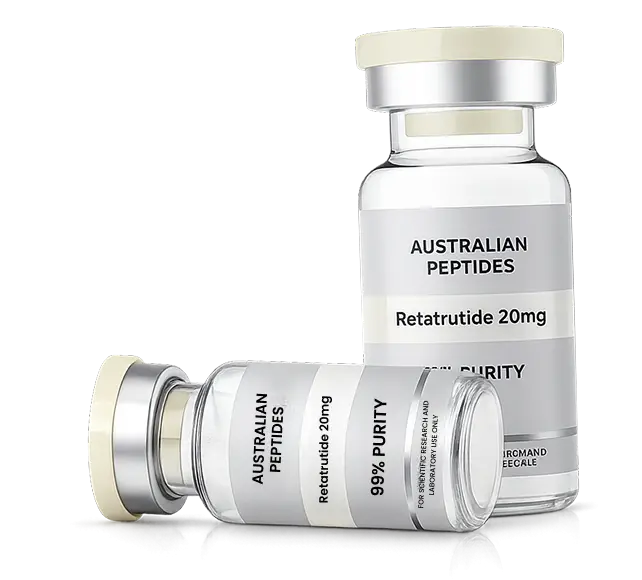
Peps Aussie supplies Retatrutide in 10mg and 20mg formats for research purposes — making it accessible to Australian researchers investigating the next generation of metabolic peptide science.
New batch COAs and restock alerts, sent when they happen.

Need more information about Peps Aussie? Get in contact with us via the email below and Peps Aussie will assist you promptly.
Include your name and a relevant subject line.
Every batch we publish a third-party certificate of analysis. Get told when a new one lands, and when a sold-out peptide is back.